PALS H’s & T’s: Reversible Causes of Pediatric Cardiac Arrest
This article explains the H’s and T’s in PALS, the reversible causes of pediatric cardiac arrest, and the key clinical clues that may help providers identify and address them during resuscitation.

During pediatric cardiac arrest, high-quality CPR, rapid defibrillation when indicated, and appropriate PALS interventions remain the immediate priorities. At the same time, the resuscitation team should be asking another critical question:
What caused the cardiac arrest — and is there something we can reverse?
This question is particularly important in pediatric resuscitation. Unlike adult cardiac arrest, cardiac arrest in infants and children is more often the result of progressive respiratory failure or shock than a primary cardiac event. Identifying the underlying cause can therefore play an important role in determining which interventions may change the course of the resuscitation.
The H’s and T’s provide a structured framework for identifying potentially reversible causes of pediatric cardiac arrest.
What Are the H’s and T’s in PALS?
The H’s
Hypovolemia
Hypoxia
Hydrogen ion (acidosis)
Hypoglycemia
Hypokalemia or hyperkalemia
Hypothermia
The T’s
Tension pneumothorax
Cardiac tamponade
Toxins
Pulmonary thrombosis
Coronary thrombosis
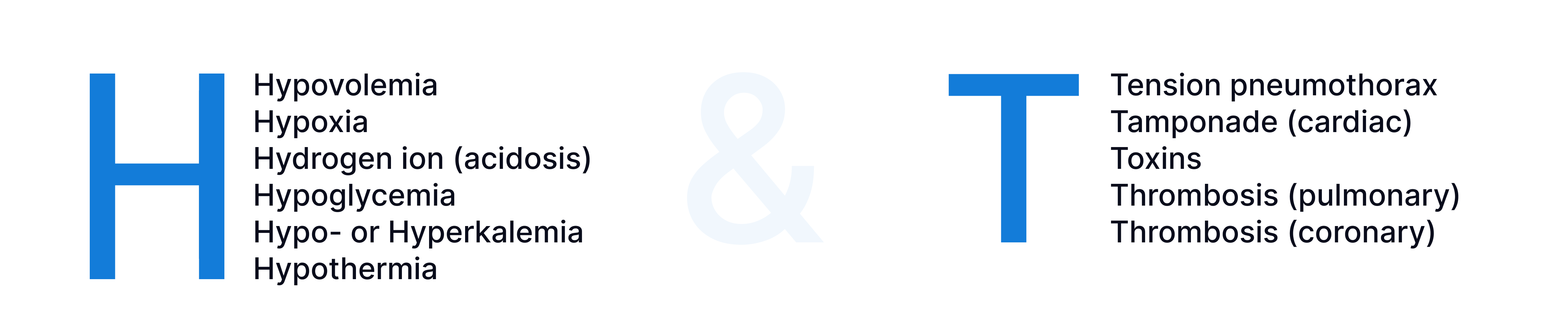
One important difference from the adult H’s and T’s in ACLS is that hypoglycemia is specifically included among the pediatric reversible causes.
The H’s and T’s are not simply terms to memorize. They help the team connect the child’s history, examination findings, arrest circumstances, available diagnostics, and response to treatment with conditions that may require targeted intervention.
Why Reversible Causes Matter During PALS
Pulseless electrical activity and asystole often occur when a severe underlying problem has progressed to the point that effective circulation can no longer be maintained.
In a child, the arrest rhythm may therefore be the final consequence of another process, such as respiratory failure, severe volume loss, an electrolyte disturbance, or an obstructive problem.
The key practical question during resuscitation is:
Which reversible cause best fits this child, and is there something we can do about it now?
The search for a cause should occur alongside, rather than instead of, the fundamentals of PALS. High-quality CPR remains the foundation of pediatric resuscitation, early epinephrine is emphasized for initial nonshockable rhythms, and rapid defibrillation remains the priority for shockable rhythms.
Using the Secondary Assessment to Identify the Cause
The search for reversible causes can begin as soon as information can be gathered without interfering with chest compressions, ventilation, defibrillation, or other critical interventions.
Useful information may come from:
The history. Consider what happened before the arrest, recent illness, respiratory symptoms, vomiting or diarrhea, trauma, medications, metabolic disorders, kidney disease, toxic exposure, congenital or acquired heart disease, or significant fluid or blood loss.
The physical examination. Findings such as major bleeding, signs of trauma, abnormal breath sounds, poor perfusion, evidence of dehydration, or other clinical clues can help narrow the differential diagnosis.
Available diagnostics. Rhythm information, point-of-care glucose, laboratory values, capnography, and selected imaging may contribute useful information when they can be obtained without delaying resuscitation.
When appropriately trained personnel are available, echocardiography may be considered to identify potentially treatable causes such as cardiac tamponade or inadequate ventricular filling. However, the AHA specifically cautions that any potential benefit must be weighed against the harm caused by prolonged interruptions in chest compressions.
The H’s
1. Hypovolemia
Hypovolemia occurs when there is not enough circulating volume to maintain adequate cardiac filling and perfusion.
In children, possible causes include:
Significant hemorrhage
Major trauma
Severe dehydration
Prolonged vomiting or diarrhea
Other substantial fluid loss
When hypovolemia is strongly suspected, treatment should focus on identifying the cause, controlling ongoing blood loss when present, and restoring circulating volume according to the clinical situation and applicable pediatric resuscitation or trauma protocol.
In pediatric traumatic cardiac arrest, AHA guidance specifically emphasizes evaluation and treatment of reversible causes such as hemorrhage while conventional resuscitation continues.
2. Hypoxia
Hypoxia is one of the most important reversible causes to consider in pediatric cardiac arrest because respiratory failure is a common pathway leading to arrest in infants and children.
Possible clues include:
Airway obstruction
Ineffective ventilation
Absent or inadequate chest rise
Severe respiratory illness before arrest
Equipment or airway problems
Inadequate oxygen delivery
The team should reassess airway patency, oxygen delivery, ventilation effectiveness, and any airway equipment already in place.
Because pediatric cardiac arrest often follows respiratory deterioration, correcting a reversible airway or ventilation problem can be particularly important. At the same time, airway interventions should not create unnecessary interruptions in chest compressions.
3. Hydrogen Ion Excess (Acidosis)
Severe acidosis can occur with prolonged cardiac arrest, shock, sepsis, renal dysfunction, and other serious metabolic conditions.
During cardiac arrest, acidosis may reflect inadequate ventilation, inadequate tissue perfusion, or both.
Management therefore focuses on:
Maintaining high-quality CPR
Supporting effective ventilation
Improving oxygenation
Restoring perfusion
Treating the underlying condition responsible for the acidosis
An important PALS point is that routine administration of sodium bicarbonate is not recommended during pediatric cardiac arrest. The 2025 AHA/AAP guidelines reserve bicarbonate for selected special circumstances, such as sodium-channel blocker toxicity or hyperkalemia.
So, the presence of “acidosis” among the H’s should not be interpreted as an automatic indication to administer sodium bicarbonate.
4. Hypoglycemia
Hypoglycemia is specifically included in the pediatric H’s and T’s.
Children may be particularly vulnerable to low blood glucose in the setting of severe illness or limited energy reserves.
Possible clues include:
Known metabolic disease
Prolonged fasting
Severe systemic illness
Abnormal point-of-care glucose
Previous episodes of hypoglycemia
If hypoglycemia is suspected and a glucose level can be obtained without interfering with resuscitation, blood glucose can help determine whether low glucose is contributing to the child’s deterioration.
Documented hypoglycemia should be treated according to the applicable pediatric emergency protocol.
AHA PALS guidance also identifies hypoglycemia as one of the correctable factors that can contribute to pediatric cardiopulmonary deterioration.
5. Hypokalemia or Hyperkalemia
Both low and high potassium concentrations can cause significant disturbances in cardiac electrical activity.
Possible clues may include:
Kidney disease
Potassium-altering medications
Potassium supplementation
Crush injury
Metabolic disease
Previous abnormal laboratory results
ECG findings compatible with an electrolyte disturbance
When an electrolyte abnormality is suspected, management should follow the appropriate pediatric electrolyte-emergency protocol.
Hyperkalemia requires particular caution. The 2025 AHA Special Circumstances guidelines state that, in adults and children with cardiac arrest from suspected hyperkalemia, the effectiveness of IV calcium, IV sodium bicarbonate, and IV insulin with glucose is not well established. Inhaled β2-agonists are not recommended during hyperkalemic cardiac arrest.
This means treatment should be based on the clinical circumstances and applicable guidance rather than assuming that one medication is universally effective.
Routine calcium administration during pediatric cardiac arrest is also not recommended unless a specific indication is present.
6. Hypothermia
Severe environmental hypothermia can cause pediatric cardiac arrest and can significantly alter the usual approach to resuscitation.
Possible clues include:
Significant cold exposure
Low core temperature
Wet clothing
Prolonged environmental exposure
Arrest occurring in a cold environment
For children with life-threatening environmental hypothermia and no obvious lethal injury, the AHA recommends full resuscitative measures concurrently with rewarming.
For children in hypothermic cardiac arrest, ECLS rewarming is considered reasonable when available. The AHA also provides specific hypothermia-related considerations for defibrillation, epinephrine, transport, and rewarming.
Because of these differences, severe hypothermic arrest should be managed using the dedicated hypothermia guidance rather than simply treating it as a standard normothermic arrest.
The T’s
1. Tension Pneumothorax
A tension pneumothorax can rapidly impair venous return and cardiac output by increasing pressure within the chest.
Possible clues include:
Significant thoracic trauma
Recent thoracic or vascular procedure
Sudden difficulty with ventilation
Markedly reduced or absent breath sounds on one side
Findings consistent with obstructive shock
This is particularly important in traumatic pediatric cardiac arrest. AHA guidance specifically recommends evaluating and treating potentially reversible causes such as tension pneumothorax during pediatric traumatic arrest.
When tension pneumothorax is strongly suspected, treatment should proceed according to the appropriate emergency or trauma protocol while interruptions in CPR are minimized.
2. Cardiac Tamponade
Cardiac tamponade occurs when fluid or blood accumulates under pressure within the pericardial space and interferes with cardiac filling.
Possible contexts include:
Penetrating or significant chest trauma
Recent cardiac procedures
Known or suspected pericardial effusion
Underlying cardiac disease
Focused echocardiography may help identify tamponade when performed by appropriately trained personnel, but it should not result in prolonged pauses in chest compressions.
When the mechanism and clinical findings strongly support tamponade, the team should prepare for emergency cause-specific treatment according to the setting and available expertise.
3. Toxins
Medication errors, accidental ingestion, intentional overdose, and environmental exposures can all contribute to life-threatening pediatric deterioration or cardiac arrest.
Possible clues include:
Known medication exposure
Missing medications
Witness or caregiver history
Toxic substances at the scene
Sudden unexplained deterioration
Clinical findings suggestive of a particular poisoning
There is no single treatment for “toxins” as a reversible cause.
The AHA 2025 Special Circumstances guidelines provide toxin-specific recommendations for multiple exposures affecting adults and children, including opioids, β-blockers, calcium channel blockers, sodium-channel blockers, local anesthetics, cyanide, digoxin-related compounds, and others.
When poisoning is suspected, standard resuscitation should continue while the team identifies the likely toxin and begins the appropriate toxin-specific management or obtains expert toxicology guidance.
4. Pulmonary Thrombosis
Pulmonary thrombosis refers to pulmonary embolic obstruction severe enough to produce critical circulatory compromise or cardiac arrest.
This is less common in children than many respiratory or shock-related causes of arrest, but it remains part of the official PALS reversible-cause checklist.
Possible clues may include:
Known thrombotic disease
Important venous thromboembolism risk factors
Sudden unexplained collapse
Severe hypoxemia
Underlying conditions associated with thrombosis
When pulmonary thrombosis is strongly suspected, the resuscitation team should use the appropriate cause-specific pathway and involve pediatric critical care, cardiology, hematology, or other relevant specialists as available.
The AHA Special Circumstances guidance addresses pulmonary embolism as a potentially reversible cause of cardiac arrest and includes advanced therapies in selected patients.
5. Coronary Thrombosis
Coronary thrombosis is also listed among the PALS reversible causes, although primary coronary ischemia is far less common as a cause of pediatric cardiac arrest than it is in adults.
Pediatric cardiac arrest related to the heart may instead involve congenital heart disease, cardiomyopathy, myocarditis, channelopathies, or coronary artery abnormalities.
The AHA notes that inherited cardiac disease and coronary artery anomalies are important potential causes of sudden unexplained cardiac arrest in children.
Possible clues may include:
Known congenital or acquired cardiac disease
Previous cardiac procedures
Sudden unexplained arrest
Evidence suggesting myocardial ischemia or coronary obstruction
Relevant findings after ROSC
When coronary obstruction is suspected, management should follow the appropriate pediatric cardiac and post–cardiac arrest pathway with early expert cardiology involvement.
A Quick PALS H’s and T’s Reference
Reversible Cause | Possible Clues | General Treatment Direction |
|---|---|---|
Hypovolemia | Hemorrhage, trauma, dehydration, major fluid loss | Control ongoing losses and restore circulating volume according to cause |
Hypoxia | Airway obstruction, ventilation failure, respiratory deterioration | Restore effective airway, oxygenation, and ventilation |
Hydrogen ion / acidosis | Prolonged arrest, shock, severe metabolic illness | Optimize CPR, ventilation, perfusion, and treat the underlying cause |
Hypoglycemia | Metabolic disease, fasting, severe illness, low glucose | Confirm when feasible and treat documented hypoglycemia per pediatric protocol |
Hypo-/hyperkalemia | Kidney disease, medications, crush injury, abnormal ECG/labs | Follow the appropriate electrolyte-emergency pathway |
Hypothermia | Cold exposure, low core temperature | Continue resuscitation while rewarming; follow hypothermia-specific guidance |
Tension pneumothorax | Trauma, procedure, sudden ventilation difficulty | Treat suspected tension physiology promptly |
Cardiac tamponade | Trauma, cardiac procedure, pericardial disease | Identify obstructive pericardial pressure and use cause-specific treatment |
Toxins | Medication error, overdose, exposure | Identify the likely toxin and begin toxin-specific management |
Pulmonary thrombosis | Thrombotic risk, sudden collapse, severe hypoxia | Use the appropriate PE/thrombosis pathway with expert consultation |
Coronary thrombosis | Cardiac disease, coronary abnormality, unexplained arrest | Use pediatric cardiac/coronary pathways with specialist involvement |
How Should the H’s and T’s Be Used During PALS?
The purpose of the H’s and T’s is not simply to memorize eleven possible diagnoses. They give the resuscitation team a shared framework for clinical reasoning while the core PALS algorithm continues.
During each cycle of CPR, the team can ask:
Was there respiratory failure before the arrest?
Has the child had major fluid loss or hemorrhage?
Could glucose or an electrolyte abnormality be contributing?
Was there significant cold exposure?
Was trauma or a recent procedure involved?
Could tension pneumothorax or tamponade explain the arrest?
Is there any possibility of medication or toxic exposure?
Does the child have cardiac or thrombotic risk factors?
One team member may be particularly useful in gathering these clues and helping the team identify which causes are most plausible while the rest of the resuscitation continues.
The most important question remains:
Which reversible cause best fits this child, and what action can the team take without compromising high-quality CPR?
Key Takeaway
The PALS H’s and T’s help healthcare professionals systematically identify potentially reversible causes of pediatric cardiac arrest. They should guide focused clinical reasoning while high-quality CPR, appropriate ventilation, rhythm management, epinephrine, and other core PALS interventions continue.
Was this article helpful?
Quick tip: Let us know if this article was helpful and discover a special discount code for your upcoming certification.
Preparing for PALS Certification?
Get officially certified in PALS online with a streamlined, flexible course designed for busy healthcare professionals. Complete it in under an hour and receive your provider card instantly.
Get Certified