2025 AHA PALS Guidelines: Key Updates & Changes
This article brings the main 2025 PALS changes into one concise review.

The 2025 American Heart Association and American Academy of Pediatrics Guidelines introduce several important updates to PALS and pediatric resuscitation, using the latest ILCOR evidence evaluations and additional pediatric evidence review.
This article focuses specifically on the 2025 PALS guideline updates and follows the approach used in the official AHA 2025 Guidelines Highlights: changes are grouped by topic, each item is labeled New or Updated, and a short Why explains the evidence or clinical concern behind it.
For more on the 2025 guideline changes across different levels of resuscitation care, you can also read:
Guidelines Framework and Systems of Care
Use one Chain of Survival across ages and settings
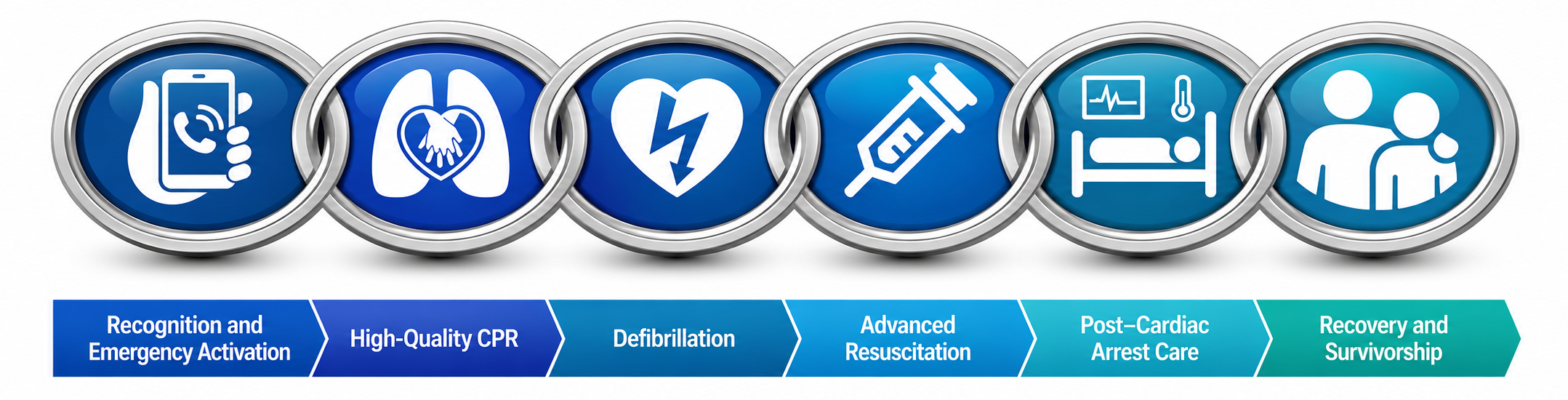
2025 (Updated): The four separate adult, pediatric, in-hospital, and out-of-hospital Chains of Survival used in 2020 have been consolidated into one 6-link Cardiac Arrest Chain of Survival for infants, children, and adults outside neonatal care.
Why: A single framework creates a consistent sequence across patient ages and care settings while supporting the full continuum from prevention and early recognition through resuscitation, post-cardiac arrest care, and recovery.
Strengthen prevention of in-hospital cardiac arrest
2025 (Updated): Adult and pediatric early warning systems and rapid response team recommendations are now aligned. For patients identified as high risk, safety huddles are newly recommended as a strategy to help prevent in-hospital cardiac arrest.
Why: Pediatric deterioration commonly precedes arrest. Early recognition, shared situational awareness, and coordinated escalation can help teams intervene sooner.
Build teams around advanced training, defined roles, and debriefing
2025 (New): New systems-of-care recommendations support including at least one team member with advanced life support training and enough team members to perform clearly defined roles. Systems may also incorporate both immediate hot debriefing and delayed cold debriefing after resuscitation events.
Why: Adequate staffing and role clarity support reliable delivery of time-sensitive interventions. Immediate and delayed debriefings can identify different performance, system, and learning needs.
Cardiac Arrest Medications
Give the first epinephrine dose early in nonshockable arrest
2025 (Updated): For cardiac arrest in an infant or child with an initial nonshockable rhythm, give the first epinephrine dose as early as reasonably possible.
Why: Pediatric observational evidence links shorter time to the first epinephrine dose with better outcomes in both in-hospital and out-of-hospital cardiac arrest.
Prioritize defibrillation before epinephrine in shockable arrest
2025 (Updated): For an infant or child with an initial shockable rhythm, rapid defibrillation remains the priority. Epinephrine may be given after 2 defibrillation attempts, or sooner only when rapid defibrillation is not possible.
Why: VF/pulseless VT requires prompt defibrillation. Giving epinephrine too early must not delay the treatment most likely to terminate a shockable rhythm.
Physiologic Monitoring During CPR
Use ETCO2 as supportive feedback, not a stopping threshold
2025 (Updated): When an infant or child has an invasive airway during CPR, end-tidal carbon dioxide (ETCO2) monitoring may be considered to help assess the response to resuscitation.
2025 (New): Do not use a specific ETCO2 cutoff by itself to decide that pediatric resuscitation should end.
Why: ETCO2 reflects pulmonary blood flow and ventilation during CPR, but survival has occurred even when values were below proposed thresholds. Interpret the trend with CPR quality, rhythm, physiology, reversible causes, and the complete clinical situation.
Use age-specific diastolic pressure targets when invasive monitoring is already present
2025 (New): When continuous invasive arterial pressure monitoring is already in place during CPR, it may be reasonable to target a diastolic pressure of at least 25 mm Hg in infants and at least 30 mm Hg in children 1 year or older.
Why: Pediatric arrest data associate pressures at or above these targets with better survival and favorable neurologic outcome. Do not interrupt resuscitation solely to place an arterial line.
Selected Cause-Directed Treatment
Recognize uncertainty in drug treatment of hyperkalemic cardiac arrest
2025 (Updated): In pediatric cardiac arrest from suspected hyperkalemia, the effectiveness of IV calcium, IV sodium bicarbonate, and IV insulin with glucose is not well established. Do not allow cause-directed treatment to interrupt high-quality CPR, defibrillation, or standard arrest care.
Why: Pediatric evidence is sparse and largely extrapolated from limited adult or nonhuman data. Potentially useful cause-directed therapy must be balanced against the risk of delaying interventions with established benefit.
Supraventricular Tachycardia With a Pulse
Expand the options for refractory SVT with cardiopulmonary compromise
2025 (Updated): For an infant or child with SVT and cardiopulmonary compromise that remains unresponsive to vagal maneuvers, adenosine, and synchronized cardioversion, IV procainamide, amiodarone, or sotalol may be considered when expert consultation is not available.
Why: Procainamide and amiodarone have moderate effectiveness but can cause adverse effects. Pediatric acute-care experience supports sotalol as another option when used with appropriate expertise, monitoring, and verified dosing guidance.
Post-Cardiac Arrest Hemodynamics
Keep systolic and mean pressure above the 10th percentile
2025 (Updated): After pediatric cardiac arrest, maintain both systolic blood pressure and mean arterial pressure above the 10th percentile for age.
Why: Hypotension is common after ROSC and is associated with worse survival. Newer observational data support maintaining both systolic and mean pressure above low age-based thresholds.
Neurologic Prognostication
Use multiple modalities to estimate neurologic outcome
2025 (Updated): Use a multimodal approach when estimating favorable or unfavorable neurologic outcome after pediatric cardiac arrest.
Why: Neurologic examination, EEG, biomarkers, and imaging have not shown enough accuracy to be used alone. Findings must be interpreted together and in the context of timing and confounders.
Do not rely on cough, gag, or pain response alone
2025 (New): The usefulness of cough or gag reflexes or response to pain as predictors of pediatric neurologic outcome is not established.
Why: Available evidence does not support treating these bedside findings as decisive stand-alone indicators of favorable or unfavorable recovery.
Use EEG within 72 hours as one part of prognostication
2025 (New): EEG findings obtained within 72 hours after pediatric cardiac arrest may support favorable or unfavorable prognostication when interpreted with other criteria.
Why: EEG can add useful information, but no EEG feature should determine the prognosis by itself.
Recovery and Follow-Up
Assess recovery needs during the first year
2025 (Updated): Evaluate pediatric cardiac arrest survivors for physical, cognitive, and emotional needs to guide follow-up care during the first year after arrest.
Why: Recovery continues after hospitalization. Survivors and families may require coordinated medical, rehabilitation, caregiver, school, and community support over time.
Was this article helpful?
Quick tip: Let us know if this article was helpful and discover a special discount code for your upcoming certification.
Preparing for PALS Certification?
Get officially certified in PALS online with a streamlined, flexible course designed for busy healthcare professionals. Complete it in under an hour and receive your provider card instantly.
Get Certified