2025 AHA ACLS Guidelines: Key Updates & Changes
This article brings the main 2025 ACLS changes into one concise review.

The 2025 American Heart Association Guidelines for CPR and Emergency Cardiovascular Care introduce several important updates to ACLS and adult advanced resuscitation, using the latest ILCOR evidence evaluations and additional AHA evidence review.
This article focuses specifically on the 2025 ACLS guideline updates and follows the approach used in the official AHA 2025 Guidelines Highlights: changes are grouped by topic, each item is labeled New or Updated, and a short Why explains the evidence or clinical concern behind it.
For more on the 2025 guideline changes across different levels of resuscitation care, you can also read:
Guidelines Framework and Systems of Care
Use one Chain of Survival across ages and settings
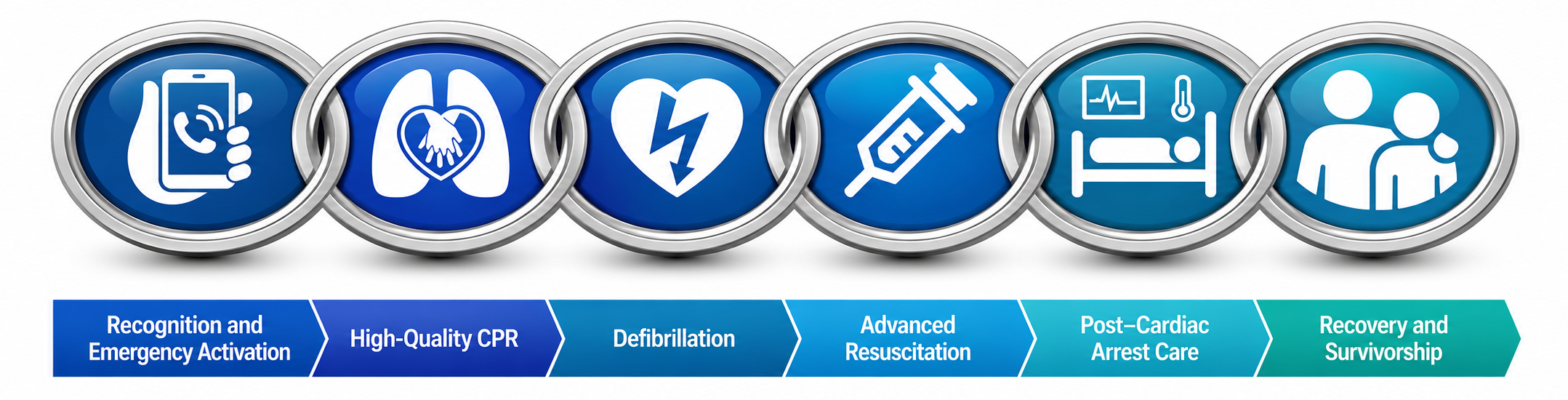
2025 (Updated): The four separate adult, pediatric, in-hospital, and out-of-hospital Chains of Survival used in 2020 have been consolidated into one 6-link Cardiac Arrest Chain of Survival for infants, children, and adults outside neonatal care.
Why: A single framework creates a consistent sequence across patient ages and care settings, from recognition and emergency activation through CPR, defibrillation, advanced resuscitation, post-cardiac arrest care, and recovery.
Strengthen prevention of in-hospital cardiac arrest
2025 (Updated): Adult and pediatric early warning systems and rapid response team recommendations are now aligned. For patients identified as high risk, safety huddles are newly recommended as a strategy to help prevent in-hospital cardiac arrest.
Why: Early recognition, shared situational awareness, and coordinated escalation can help teams act before deterioration progresses to arrest.
Build teams around advanced training, defined roles, and debriefing
2025 (New): New systems-of-care recommendations support including at least one team member with advanced life support training and enough team members to perform clearly defined roles. Systems may also incorporate both immediate hot debriefing and delayed cold debriefing after resuscitation events.
Why: Adequate staffing and role clarity support reliable delivery of time-sensitive interventions. Immediate and delayed debriefings can identify different performance, system, and learning needs.
Continue most out-of-hospital resuscitations on scene
2025 (New): In most adult out-of-hospital cardiac arrests, it is reasonable for EMS systems to continue resuscitation at the scene rather than transport early with CPR in progress, while following local protocols and recognized exceptions. EMS professionals should also receive training in compassionate death notification when resuscitation ends on scene.
Why: Transport during active resuscitation can compromise CPR quality and create safety risks. On-scene care allows the team to focus on high-quality resuscitation and make protocol-guided transport or termination decisions.
Cardiac Arrest Defibrillation, Adjuncts, and Termination Decisions
Vector change and double sequential defibrillation remain uncertain
2025 (New): The usefulness of vector change defibrillation has not been established for persistent VF/pulseless VT after 3 or more consecutive shocks.
2025 (Updated): The usefulness of double sequential defibrillation has also not been established for persistent VF/pulseless VT after 3 or more consecutive shocks.
Why: The evidence includes one small randomized trial, and important questions about effectiveness, technique, and implementation remain unresolved. These strategies should not displace proven resuscitation priorities.
Do not use head-up CPR outside clinical trials
2025 (New): Head-up CPR is not recommended for adults in cardiac arrest except in a clinical trial.
Why: Available studies are observational, methodologically limited, and provide very low-certainty evidence for survival or favorable neurologic outcome.
Use POCUS cautiously without interrupting CPR
2025 (Updated): An experienced clinician may consider point-of-care ultrasonography (POCUS) during adult cardiac arrest to look for a reversible cause only when it can be performed without interrupting CPR. Its usefulness remains uncertain, and ultrasound findings should not be used alone for prognosis or termination decisions.
Why: POCUS may reveal a treatable cause, but image acquisition and interpretation can prolong pauses or mislead the team when used without the full clinical context.
Match the termination rule to the EMS response and do not use ETCO2 alone
2025 (Updated): Apply a validated termination-of-resuscitation rule that matches the responding professionals' scope of practice. In a tiered EMS system staffed by both BLS and ALS professionals, use of the validated universal termination-of-resuscitation rule is reasonable for adult out-of-hospital cardiac arrest.
2025 (Updated): Do not use a single end-tidal carbon dioxide (ETCO2) value by itself to end resuscitation. In an intubated adult, failure to achieve an ETCO2 greater than 10 mm Hg after 20 minutes of ALS may be considered only as one part of a multimodal decision.
Why: Validated rules perform differently according to the responding system. ETCO2 is affected by CPR quality, ventilation, medications, airway management, and arrest cause, so it cannot determine futility by itself.
Vascular Access and Arrest Medications
Attempt IV access before IO access
2025 (Updated): Attempt intravenous access first for medication delivery during adult cardiac arrest. Use intraosseous access when IV attempts are unsuccessful or IV placement is not feasible.
Why: A recent ILCOR review found no outcome advantage for initial IO access and identified lower odds of sustained ROSC with IO compared with IV access.
Do not give intra-arrest medications through an endotracheal tube
2025 (Updated): Administration of intra-arrest medications through an in-place endotracheal tube has been removed from the adult ALS guidance. Use an IV route first or IO access when IV access is not feasible or is delayed.
Why: Endotracheal drug administration produces low, unpredictable blood concentrations, while modern vascular access provides more reliable delivery.
Give epinephrine after initial shocks fail in shockable arrest
2025 (Updated): For adult cardiac arrest with a shockable rhythm, it is reasonable to administer epinephrine after initial CPR and defibrillation attempts have not succeeded.
Why: Rapid defibrillation remains the first medication-independent priority in VF/pulseless VT. Epinephrine follows when initial shocks and CPR do not restore circulation.
Do not substitute vasopressin for epinephrine
2025 (Updated): Vasopressin alone, or vasopressin combined with epinephrine, offers no advantage over epinephrine for adult cardiac arrest.
Why: Reviews of randomized and observational studies have not found better survival with vasopressin alone or in combination.
Recognize uncertain benefit from other antiarrhythmics
2025 (New): The benefit of beta-blockers, bretylium, procainamide, or sotalol for VF/pulseless VT that remains refractory to defibrillation is uncertain.
Why: The latest evidence review did not identify new evidence establishing effectiveness or safety for these agents during cardiac arrest.
Recognize uncertainty in drug treatment of hyperkalemic cardiac arrest
2025 (Updated): In adult cardiac arrest from suspected hyperkalemia, the effectiveness of IV calcium, IV sodium bicarbonate, and IV insulin with glucose is not well established. Do not allow cause-directed treatment to interrupt high-quality CPR, defibrillation, or standard arrest care.
Why: Human evidence for improved survival or favorable neurologic outcome is limited and uncertain. Potentially useful cause-directed therapy must be balanced against the risk of delaying interventions with established benefit.
Clinical Stability and Peri-Arrest Rhythms
Determine whether the arrhythmia is causing or reflecting instability
2025 (Updated): Rapidly assess perfusion and determine whether an arrhythmia is the likely cause of instability or a response to another problem. Poor perfusion may appear as hypotension, altered mental status, signs of shock, ischemic chest discomfort, or acute heart failure.
Why: Treating the rhythm alone may not correct instability caused by hypoxia, shock, ischemia, or another underlying condition. The proximal cause should guide the sequence of ALS treatment.
Use synchronized cardioversion for unstable wide-complex tachycardia
2025 (Updated): Perform synchronized cardioversion for an adult with hemodynamically unstable wide-complex tachycardia.
Why: Instability requires rapid rhythm correction, and synchronized cardioversion has a high likelihood of terminating the tachycardia.
Escalate stable wide-complex tachycardia when initial treatment fails
2025 (Updated): For hemodynamically stable wide-complex tachycardia, use synchronized cardioversion when appropriate vagal maneuvers and pharmacologic treatment are ineffective or contraindicated.
Why: A patient who remains in wide-complex tachycardia after appropriate initial measures may require electrical conversion to restore an effective rhythm.
Defibrillate sustained polymorphic VT immediately
2025 (Updated): Treat all sustained polymorphic ventricular tachycardia as unstable and deliver an immediate high-energy unsynchronized shock. Do not delay defibrillation while considering medication for the underlying cause or recurrence.
Why: Polymorphic VT cannot be synchronized reliably and can rapidly eliminate cardiac output or deteriorate to VF.
Start atrial fibrillation or flutter cardioversion at 200 J or higher
2025 (Updated): For synchronized cardioversion of atrial fibrillation or atrial flutter with a currently approved biphasic defibrillator, an initial setting of at least 200 J is reasonable. Increase energy after shock failure according to the device.
Why: Newer evidence supports greater first-shock success and lower cumulative energy when cardioversion starts at 200 J instead of using a low-energy stepwise approach.
Do not use double synchronized cardioversion as a routine first strategy
2025 (New): The usefulness of double synchronized cardioversion as an initial treatment for atrial fibrillation is uncertain.
Why: Standard biphasic synchronized cardioversion already has a high success rate, so the added benefit of a double synchronized approach appears limited.
Use temporary transvenous pacing for refractory unstable bradycardia
2025 (New): Temporary transvenous pacing is reasonable for persistent hemodynamically unstable bradycardia that does not respond to medical treatment.
Why: Transvenous pacing can improve heart rate and perfusion while the underlying cause is corrected or definitive pacing is arranged.
Adult Post-Cardiac Arrest Stabilization
Maintain a MAP of at least 65 mm Hg
2025 (Updated): Avoid hypotension after ROSC by maintaining a mean arterial pressure of at least 65 mm Hg.
Why: Randomized trials have not shown better survival or neurologic outcome from routinely targeting a higher MAP.
Consider broader diagnostic imaging after ROSC
2025 (New): Head-to-pelvis CT may be reasonable after ROSC to investigate the arrest cause and complications of resuscitation. Echocardiography or point-of-care cardiac ultrasound may also be reasonable to identify important diagnoses that require intervention.
Why: These studies can reveal clinically significant causes or complications that may not be apparent from the initial examination and ECG.
Continue temperature control for at least 36 hours
2025 (Updated): For an adult who remains unresponsive to verbal commands after ROSC, it is reasonable to maintain a deliberate temperature-control strategy for at least 36 hours.
Why: Current evidence supports either hypothermic temperature control or normothermia with fever prevention. The guideline identifies 36 hours as the minimum total duration.
Perform coronary angiography before discharge when cardiac cause is suspected
2025 (Updated): Coronary angiography is recommended before hospital discharge for adult cardiac arrest survivors with a suspected cardiac cause, particularly after an initial shockable rhythm, unexplained left ventricular systolic dysfunction, or evidence of severe myocardial ischemia.
Why: Coronary artery disease is common after out-of-hospital cardiac arrest, and identifying unstable coronary disease can lead to treatment that improves outcomes.
Do not use temporary mechanical circulatory support routinely
2025 (New): Do not routinely use temporary mechanical circulatory support for cardiogenic shock after cardiac arrest and ROSC. It may be considered for a highly selected adult with refractory cardiogenic shock despite standard treatment.
Why: Evidence does not support routine use and these devices carry important risks and resource requirements. A selected patient may still benefit when temporary support provides a bridge to treatment or recovery.
Neurologic Care, Prognostication, and Recovery
Obtain EEG promptly for myoclonus and do not suppress movement without an EEG correlate
2025 (New): Promptly obtain and interpret EEG when an adult has myoclonus after ROSC. Do not treat myoclonus solely to suppress the movement when there is no corresponding seizure activity on EEG.
Why: Clinical appearance cannot reliably distinguish myoclonic seizures from myoclonus without an EEG correlate. Medication adverse effects may outweigh an unproven benefit when no seizure activity is present.
Consider a nonsedating antiseizure medication trial for selected EEG patterns
2025 (New): A therapeutic trial of a nonsedating antiseizure medication may be reasonable for an adult who does not follow commands after ROSC and has an EEG pattern on the ictal-interictal continuum.
Why: These EEG patterns may represent potentially treatable abnormal activity, but the uncertain benefit and the risk of sedation support a cautious, individualized trial.
Keep neuroprognostication multimodal and add NfL as a biomarker option
2025 (Updated): Do not base neurologic prognosis on one finding. When combined with other prognostic tests, high serum neuron-specific enolase or neurofilament light chain (NfL) values within 72 hours may support an unfavorable prognosis in a patient who remains comatose.
Why: NfL is a newly added serum biomarker, but biomarkers can be affected by timing, assay methods, and confounders. Multimodal assessment reduces the risk of a falsely pessimistic prognosis.
Add EEG predictors of favorable outcome
2025 (New): A continuous EEG background without discharges during the first 72 hours may support a favorable neurologic prognosis when interpreted with other prognostic tests.
Why: The 2025 guidance adds predictors of favorable outcome, but no single EEG feature should determine prognosis in isolation.
Assess survivors and caregivers for emotional distress
2025 (Updated): After medical stabilization and before hospital discharge, provide cardiac arrest survivors and their caregivers with structured assessment and treatment of, or referral for, emotional distress.
Why: Emotional distress affects a substantial proportion of survivors and caregivers, and psychosocial interventions can improve these outcomes.
Support the well-being of rescuers and healthcare professionals
2025 (New): Interventions that address healthcare professional burnout may be beneficial. Debriefing and referral for emotional support may also help lay rescuers, EMS professionals, and hospital-based clinicians after a cardiac arrest event.
Why: Resuscitation can cause significant distress. Structured support can help teams address both performance learning and the emotional effects of caring for a patient in cardiac arrest.
Was this article helpful?
Quick tip: Let us know if this article was helpful and discover a special discount code for your upcoming certification.
Preparing for ACLS Certification?
Get officially certified in ACLS online with a streamlined, flexible course designed for busy healthcare professionals. Complete it in under an hour and receive your provider card instantly.
Get Certified