2025 AHA BLS Guidelines: Key Updates & Changes
This article brings the main 2025 BLS changes into one concise review.

The 2025 American Heart Association Guidelines for CPR and Emergency Cardiovascular Care introduce several important updates to BLS and basic life support, using the latest ILCOR evidence evaluations and additional AHA evidence review.
This article focuses specifically on the 2025 BLS guideline updates and follows the approach used in the official AHA 2025 Guidelines Highlights: changes are grouped by topic, each item is labeled New or Updated, and a short Why explains the evidence or practical concern behind it.
For more on the 2025 guideline changes across different levels of resuscitation care, you can also read:
Guidelines Framework and Terminology
Use one Chain of Survival across ages and settings
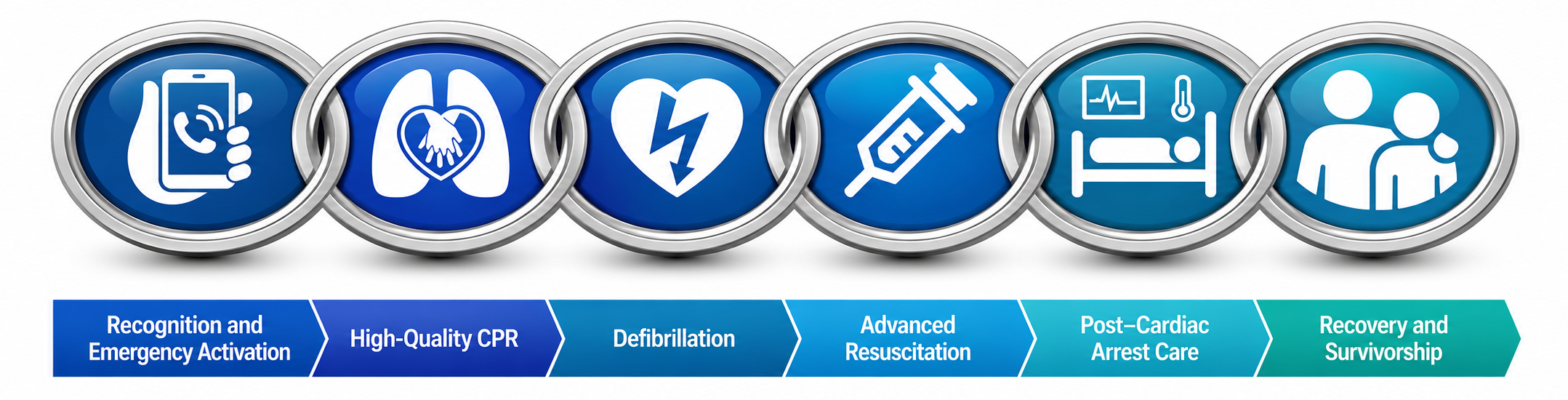
2025 (Updated): The four separate adult, pediatric, in-hospital, and out-of-hospital Chains of Survival used in 2020 have been consolidated into one 6-link Cardiac Arrest Chain of Survival for infants, children, and adults outside neonatal care.
Why: A single framework makes the overall sequence consistent across patient ages and care settings while preserving the continuum from recognition and emergency activation through CPR, defibrillation, advanced resuscitation, post-cardiac arrest care, and recovery.
Use the updated breathing terminology
2025 (Updated): The term rescue breaths is no longer used in the guidelines. Use breaths when a person with a pulse is not breathing normally and when breaths are given with CPR. Reserve ventilations for assisted breathing delivered by healthcare professionals with a device such as a bag-mask device or advanced airway.
Why: Standardized terminology reduces ambiguity across BLS, advanced life support, and resuscitation education.
Differentiate telecommunicator CPR instructions for adults and children
2025 (Updated): Emergency telecommunicators should guide lay rescuers toward Hands-Only CPR for adults and CPR with compressions and breaths for children.
Why: Randomized adult evidence supports telecommunicator-assisted compression-only CPR, while pediatric arrests are more often respiratory and benefit from breaths with compressions.
Pediatric CPR, Ventilation, and Defibrillation
Keep CPR pauses, including peri-shock pauses, under 10 seconds
2025 (New): During cardiac arrest in an infant or child, minimize interruptions and keep pauses in chest compressions to less than 10 seconds, including the pauses immediately before and after shock delivery.
Why: Pediatric registry data associate more frequent and longer pauses with a lower likelihood of return of spontaneous circulation (ROSC). Prolonged peri-shock pauses also reduce blood flow and oxygen delivery to the heart and brain.
Use an effective infant compression technique
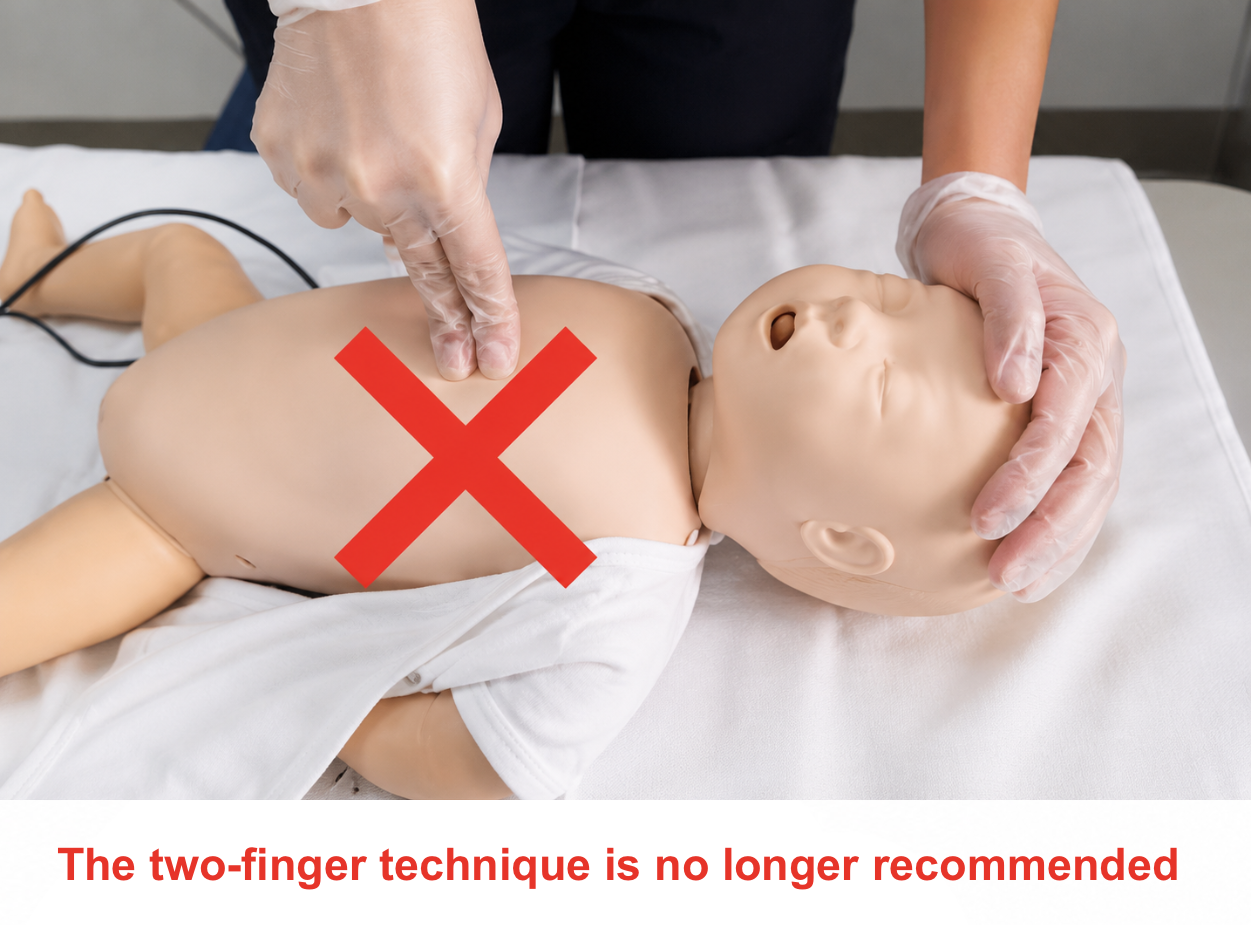
2025 (Updated): Compress an infant's sternum with either the two-thumb encircling-hands technique or the heel of one hand. If the rescuer cannot encircle the chest, use the heel of one hand. The two-finger technique is no longer recommended.
Why: Simulation reviews and pediatric observational data show that the recommended techniques are more likely to produce adequate compression depth. The two-finger technique performed poorly in the available data.
Attach an AED promptly and use pediatric attenuation when available
2025 (Updated): Attach an AED as soon as possible during cardiac arrest in an infant or child. For a child younger than 8 years, use a pediatric attenuator and pediatric pads when available. If neither a manual defibrillator nor an AED with pediatric attenuation is available, an AED without attenuation may be considered.
Why: Defibrillation is the definitive treatment for VF/pulseless VT. Pediatric attenuation provides a more appropriate energy dose, but lack of pediatric equipment should not prevent use of the only available AED when a shockable rhythm is present.
Pediatric Foreign-Body Airway Obstruction
Begin the child choking sequence with back blows
2025 (Updated): For a responsive child with severe foreign-body airway obstruction, alternate 5 back blows with 5 abdominal thrusts until the object is expelled or the child becomes unresponsive.
Why: Observational evidence suggests that back blows can clear an obstruction effectively. Starting with back blows also creates a consistent sequence across age groups while retaining abdominal thrusts for children.
Use back blows and chest thrusts for an infant
2025 (Updated): For a responsive infant with severe foreign-body airway obstruction, alternate 5 back blows with 5 chest thrusts until the object is expelled or the infant becomes unresponsive. Use the heel of one hand for the chest thrusts.
Why: Abdominal thrusts can injure an infant's abdominal organs. The updated technique clarifies how to deliver chest thrusts without treating them as full CPR compressions.
Adult CPR Positioning and Quality
Perform CPR where the person is found when it can be done safely
2025 (Updated): In most adult cardiac arrests, begin and continue resuscitation where the person is found if high-quality CPR can be performed safely and effectively. Use a firm surface when possible, and position the rescuer so the patient's torso is approximately level with the rescuer's knees. The supine position is preferred, but prone CPR may be considered if turning the person is not possible or would significantly delay compressions.
Why: Moving a person can delay compressions and interrupt blood flow. Firm support and effective rescuer body position improve compression mechanics.
Use standard CPR technique for adults with obesity
2025 (New): Provide CPR to an adult with obesity using the same compression and ventilation techniques used for an adult without obesity.
Why: A broad evidence review did not identify support for changing standard CPR technique solely because a patient has obesity.
Reserve mechanical CPR for selected circumstances
2025 (Updated): Do not use a mechanical chest compression device routinely during adult cardiac arrest.
2025 (New): A mechanical device may be considered when high-quality manual compressions are difficult or dangerous to provide, as long as deployment and removal do not create prolonged CPR interruptions.
Why: Trials have not shown better survival with routine mechanical CPR. A device may still offer a practical or safety advantage in selected situations that are not well represented in clinical trials.
Adult Airway and Ventilation
Open the airway when jaw thrust is ineffective
2025 (Updated): For an adult with suspected head or neck trauma, begin with a jaw thrust and an airway adjunct when appropriate. If these measures do not open the airway, a trained rescuer should use a head tilt–chin lift.
Why: Limiting cervical movement is important, but a patent airway and effective oxygenation and ventilation take priority when the initial maneuver fails.
Provide compressions with effective breaths
2025 (Updated): Healthcare professionals should provide chest compressions and breaths for adult cardiac arrest from cardiac or noncardiac causes. Before an advanced airway is placed, cycles of 30 compressions and 2 breaths are reasonable. A lay rescuer who is trained, willing, and able may also provide CPR with breaths.
Why: Breaths remain important, especially when arrest follows a respiratory or noncardiac cause. The 30:2 sequence also creates regular opportunities to observe chest rise and correct ineffective breathing technique.
Use visible chest rise and avoid inadequate or excessive ventilation
2025 (Updated): During adult cardiac arrest, deliver each breath with enough volume to produce visible chest rise. Avoid both hypoventilation and hyperventilation.
Why: Studies show that breaths delivered during CPR are often outside guideline targets. Too little ventilation may not oxygenate effectively, while excessive rate or volume can impair circulation.
Adult Defibrillation and Foreign-Body Airway Obstruction
Adjust a bra when applying defibrillation pads
2025 (New): When applying defibrillation pads to an adult in cardiac arrest, it may be reasonable to move a bra out of the way instead of removing it completely. Pads must still be placed directly on bare skin in the correct positions.
Why: Women receive public-access defibrillation less often than men. Reducing unnecessary chest exposure may remove one barrier to prompt pad application.
Add back blows before abdominal thrusts
2025 (Updated): For a responsive adult with severe foreign-body airway obstruction, alternate 5 back blows with 5 abdominal thrusts until the object is expelled or the person becomes unresponsive. Use chest thrusts instead of abdominal thrusts in late pregnancy or when the abdomen cannot be effectively encircled.
Why: Adult observational data associate back blows with better obstruction relief and fewer injuries than abdominal thrusts alone. The alternating sequence also aligns the adult approach with the pediatric sequence.
Selected Special Situations
Prepare immediately for resuscitative delivery
2025 (Updated): When cardiac arrest occurs during pregnancy and resuscitative delivery is indicated, preparation should begin as soon as the arrest is recognized, with a goal of completing delivery by 5 minutes.
Why: Preparation must occur alongside standard resuscitation, team planning, and manual left uterine displacement. Early resuscitative delivery can improve the pregnant patient's chance of successful resuscitation when ROSC is not achieved.
Recognize naloxone in the adult BLS algorithm without delaying standard care
2025 (New): Naloxone use by lay rescuers is now incorporated into the adult BLS algorithm for suspected opioid-associated respiratory arrest and cardiac arrest. In cardiac arrest, a rescuer may give naloxone only if doing so does not interrupt or delay high-quality CPR with breaths, emergency activation, or defibrillation.
Why: Naloxone can reverse opioid-related respiratory arrest. Its benefit after cardiac arrest is not established, so standard resuscitation remains the priority.
Expand public access to naloxone
2025 (New): Systems should support public policies that permit good-faith naloxone use and programs that increase naloxone availability to lay rescuers.
Why: Observational evidence associates wider naloxone access and legal protections for good-faith use with lower opioid-overdose mortality.
Was this article helpful?
Quick tip: Let us know if this article was helpful and discover a special discount code for your upcoming certification.
Preparing for BLS Certification?
Get officially certified in BLS online with a streamlined, flexible course designed for busy healthcare professionals. Complete it in under an hour and receive your provider card instantly.
Get Certified