ACPE Credit: Continuing Pharmacy Education for Pharmacists
Learn what ACPE credit is, how contact hours and CEUs are calculated, what an ACPE Universal Activity Number means, and how pharmacists claim and document continuing pharmacy education through CPE Monitor.

If you are a pharmacist renewing your license, maintaining a professional certification, or completing an employer education requirement, you have probably encountered the terms ACPE credit and continuing pharmacy education, or CPE.
This guide explains what ACPE credit means, who can use it, how contact hours and CEUs are calculated, what information is contained in an ACPE Universal Activity Number, and how eligible credit is recorded in CPE Monitor.
Quick Answer: What Is ACPE Credit?
ACPE credit is continuing pharmacy education credit awarded after a pharmacist or pharmacy technician successfully completes an eligible educational activity offered by an ACPE-accredited or Jointly Accredited provider.
ACPE stands for the Accreditation Council for Pharmacy Education. ACPE accredits providers of continuing pharmacy education and establishes standards covering activity planning, educational content, learning objectives, assessment, evaluation, and independence.
For U.S. pharmacists and pharmacy technicians, completed ACPE credit is normally transmitted electronically to CPE Monitor®, the national tracking system developed by ACPE and the National Association of Boards of Pharmacy.
What Does ACPE Credit Show?
ACPE credit shows that a learner successfully completed a continuing pharmacy education activity offered by an eligible provider and met the activity’s stated completion requirements.
According to the ACPE Standards for Continuing Pharmacy Education, CPE is intended to help pharmacists and pharmacy technicians maintain and improve their professional competence through structured education that supports problem-solving, critical thinking, and pharmacy practice.
Depending on the activity, successful completion may require:
Participating in the required educational content
Completing an assessment or post-test
Achieving a specified passing score
Submitting an activity evaluation
Completing a skills-based or practice component
Meeting other requirements established by the provider
ACPE recognizes knowledge-based, application-based, and certificate program activities. The educational and assessment requirements depend on the type and purpose of the activity.
The provider determines the amount of credit available before offering the activity. For live education, 60 minutes equals 1.0 contact hour or 0.1 CEU. Home-study credit must be based on a documented and defensible estimate of the time required for successful completion. ACPE providers generally award full credit after successful completion of an activity rather than partial credit.
ACPE Contact Hours vs. CEUs
Contact hours and continuing education units, or CEUs, are two ways of expressing the same amount of ACPE continuing pharmacy education.
Unit | Meaning |
|---|---|
1 contact hour | 60 minutes of an organized educational activity |
0.1 CEU | 1 contact hour |
1.0 CEU | 10 contact hours |
For example:
4.0 contact hours = 0.4 CEUs
8.0 contact hours = 0.8 CEUs
10.0 contact hours = 1.0 CEU
A listing that offers 8.0 contact hours and 0.8 CEUs is not offering two separate forms of credit. Both numbers describe the same amount of continuing pharmacy education.
What Is an ACPE Universal Activity Number?
Every eligible ACPE continuing pharmacy education activity is assigned a Universal Activity Number, commonly called a UAN.
The UAN allows the provider, learner, ACPE, NABP, and licensing boards to identify the specific educational activity. It is also used when the provider transmits completed credit to CPE Monitor.
A UAN generally identifies:
The accredited provider or joint providership
The year in which the activity was created
The activity sequence number
Whether the activity is live or home study
The activity’s topic designator
Whether the credit is designated for pharmacists or pharmacy technicians
The final letter is particularly important:
P designates an activity for pharmacists
T designates an activity for pharmacy technicians
The activity format is also shown in the UAN:
H identifies a home-study activity
L identifies a live activity
For example, a UAN ending in H04-P identifies a home-study activity designated for pharmacists. Pharmacists and technicians should confirm that the final audience designation matches their professional role before beginning an activity.
The ACPE Universal Activity Number guide explains each part of the UAN and how it is used to identify an activity and submit credit.
Who Can Use ACPE Credit?
ACPE continuing pharmacy education is primarily intended for:
Licensed pharmacists
Pharmacy technicians
However, not every activity is automatically designated for both groups. A provider may offer an activity for pharmacists, pharmacy technicians, or both, with a separate UAN for each eligible audience.
A pharmacist should generally look for a UAN ending in P, while a pharmacy technician should look for a UAN ending in T.
Do All States Require the Same Number of Pharmacy CE Hours?
No. There is no single nationwide continuing education requirement that applies to every pharmacist.
Requirements vary by state, license type, renewal cycle, practice authority, and professional certifications. States may also require education in specific subjects or limit how many hours can be completed through a particular learning format.
The following examples show how requirements can differ. They reflect information published by the respective boards as of November 2026:
State | Example of pharmacist continuing education requirement |
|---|---|
California | The California State Board of Pharmacy requires pharmacists to complete 30 hours of CE every two years. This includes Board-provided law and ethics webinars and at least one hour of cultural competency education. The Board-provided webinars are not ACPE activities and do not appear in CPE Monitor. |
Texas | The Texas State Board of Pharmacy requires at least 30 hours of approved CE every two years for a regular active license. Requirements include education related to Texas pharmacy laws or rules and human trafficking prevention. Additional requirements may apply to new pharmacists and pharmacists holding special certifications. |
Florida | The Florida Board of Pharmacy requires 30 hours per biennium: 26 general hours, two hours related to controlled substances, and two hours related to medication errors. Additional requirements may apply to pharmacists with immunization, collaborative practice, or test-and-treat certifications. |
These examples should not be treated as a national average. A state may require mandatory topics, live education, board-approved courses, or reporting through a separate state system in addition to accepting ACPE credit.
Always review the current rules published by the board responsible for your license before selecting an activity.
Can You Earn ACPE Credit Online?
Yes. An ACPE continuing pharmacy education activity does not have to take place in a classroom.
Online, self-paced activities may be offered as home-study activities, also called enduring materials. ACPE defines enduring materials as printed, recorded, or computer-assisted educational activities that do not include direct interaction between faculty and participants.
The activity must still be offered by an eligible provider, carry an appropriate UAN, and include the required method of assessing successful completion.
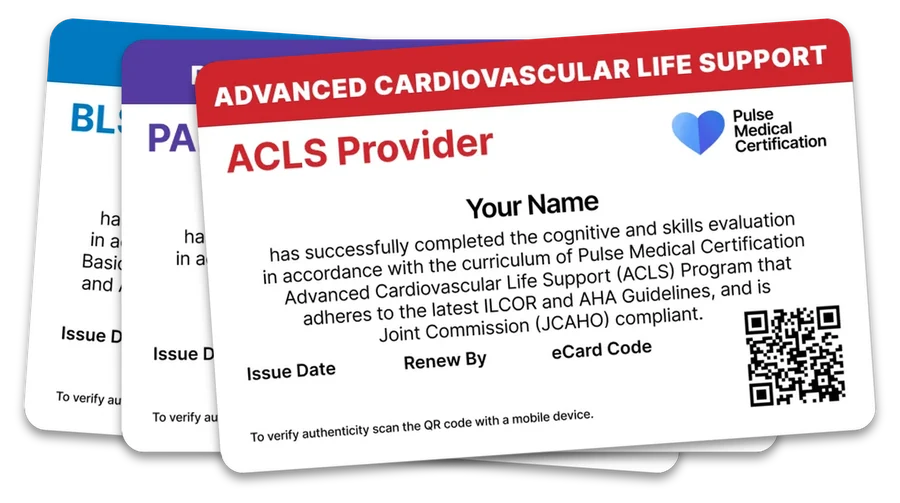
Eligible pharmacists who complete qualifying Pulse Medical Certification ACLS, PALS, and BLS activities can earn continuing pharmacy education through our joint providership with CME Outfitters, LLC.
The current activities are knowledge-based home-study activities designated for:
Activity | ACPE credit | Universal Activity Number |
|---|---|---|
8.0 contact hours (0.8 CEUs) | JA0007185-9999-26-165-H04-P | |
8.0 contact hours (0.8 CEUs) | JA0007185-9999-26-166-H04-P | |
4.0 contact hours (0.4 CEUs) | JA0007185-9999-26-005-H04-P |
For complete accreditation statements, activity dates, and profession-specific credit information, visit our Accreditation & Continuing Education page.
How Do You Claim and Document ACPE Credit?
The exact process depends on the activity provider, but the general sequence is:
Complete the educational activity. Work through the required content and meet all participation requirements.
Complete the assessment and evaluation. The provider may require a post-test, minimum passing score, activity evaluation, or another method of confirming successful completion.
Provide your NABP information. Enter your correct NABP e-Profile ID and date of birth in the format requested by the provider. Incorrect information can cause CPE Monitor to reject the credit record.
Submit the credit claim within the stated deadline. Do not wait until the end of your license renewal cycle. ACPE permits providers to transmit participant information for up to 60 days following completion, but an individual provider may establish an earlier submission deadline.
Verify the activity in CPE Monitor. Log in to your NABP e-Profile and confirm that the activity title, completion date, UAN, contact hours, and CEUs are correct.
Save your records. Download or retain your CPE Monitor transcript and any completion certificate supplied by the provider for as long as your licensing board requires.
For Pulse Medical Certification activities, pharmacists claim credit through the link provided after completing the course, complete the online post-test and evaluation, and provide their NABP e-Profile ID and date of birth. Eligible pharmacy credit is then reported to CPE Monitor by our accreditation partner within 60 days.
For U.S. pharmacists and pharmacy technicians, the official record of ACPE credit is the activity recorded in CPE Monitor, not merely a general course completion certificate.
If an activity does not appear in your NABP profile, ACPE recommends contacting the activity provider first. If the provider cannot resolve the issue, contact CPE Monitor for assistance. CPE Monitor documents completed ACPE activities, but the applicable state board determines whether a particular activity satisfies its licensing requirements. An activity may provide valid ACPE credit without satisfying a state-specific mandatory topic, live-hour requirement, or other special condition.
Was this article helpful?
Quick tip: Let us know if this article was helpful and discover a special discount code for your upcoming certification.
Get Certified. Earn CME/CE Credits.
Complete an ACLS, PALS, or BLS certification or recertification course and earn eligible, profession-specific continuing education credit upon successful completion.
Explore All Certifications