ANCC Contact Hours: Continuing Education for Nurses
Learn what ANCC contact hours are, who can use them, how they differ from CEUs, and how nurses can claim and document eligible continuing education.
If you are a nurse renewing your license, maintaining a professional certification, or meeting an employer’s continuing education requirements, you have probably seen the term ANCC contact hours.
This guide explains what ANCC contact hours are, how they are calculated, how they differ from CEUs, who can use them, and how to claim and document eligible nursing continuing education.
Quick Answer: What Are ANCC Contact Hours?
ANCC contact hours are a unit of nursing continuing professional development credit awarded after successful completion of an eligible educational activity. The contact hours must be awarded by an organization authorized to provide nursing continuing education through ANCC accreditation, an ANCC-accredited approver, or Joint Accreditation.
ANCC stands for the American Nurses Credentialing Center. ANCC uses the term Nursing Continuing Professional Development, or NCPD, for educational activities intended to help nurses maintain and improve their knowledge, skills, and professional practice.
According to the ANCC NCPD Accredited Provider Policy and Operations Manual, one contact hour represents 60 minutes of organized learning.
For live activities, breaks and meals are not included in the contact-hour calculation. For online and other enduring materials, the provider must use a documented and defensible method to determine the amount of credit awarded.
What Does an ANCC Contact Hour Show?
An ANCC contact hour shows that a learner completed an educational activity planned under recognized nursing continuing professional development standards and met the provider’s stated requirements.
Depending on the activity, successful completion may require:
Participating in the educational content
Completing an assessment or post-test
Submitting an activity evaluation or self-reflection
Demonstrating a skill or completing another required learning activity
Meeting other completion criteria established by the provider
A certificate or other documentation of completion should identify the learner, activity title, completion date, provider, number of contact hours awarded, and the applicable accreditation statement.
ANCC Contact Hours vs. CEUs
The terms ANCC contact hour and CEU are sometimes used interchangeably in casual conversation, but they are not the same unit.
ANCC Contact Hour | Continuing Education Unit (CEU) |
|---|---|
1.0 contact hour represents 60 minutes of organized learning | 1.0 CEU represents 10 contact hours |
Used by the ANCC NCPD Accreditation Program | Defined under the IACET continuing education framework |
Usually reported directly as contact hours | Often reported in tenths, such as 0.1 CEU |
Example: 8.0 contact hours | Equivalent IACET measurement: 0.8 CEU |
The ANCC provider manual instructs accredited providers to use Contact Hours, not CEUs, when describing ANCC nursing continuing professional development credit. Always check the exact unit printed on your completion certificate before reporting continuing education.
Who Can Use ANCC Contact Hours?
ANCC contact hours are primarily intended for nurses and may be relevant to:
Registered Nurses (RNs)
Advanced Practice Registered Nurses (APRNs), including nurse practitioners and clinical nurse specialists
Licensed Practical Nurses and Licensed Vocational Nurses (LPNs/LVNs), when accepted by their state board
Nurses maintaining a specialty certification
Nurses completing employer, hospital, or credentialing requirements
Acceptance is not identical across every license, certification, or organization. Nurses should confirm the requirements of their state board of nursing, certification body, and employer.
ANCC Certification Renewal
ANCC certification renewal is separate from state nursing license renewal.
The ANCC certification renewal requirements generally include 75 continuing education contact hours relevant to the nurse’s certification role and specialty, together with an additional professional development category. APRN certificants also have advanced pharmacology requirements.
ANCC advises certificants to use the renewal handbook applicable to their application date because specific policies and reporting procedures can change.
ANCC also states that contact hours from ACLS, PALS, BLS, and similar programs may be used for the applicable course content once during a five-year ANCC certification renewal period. State boards and other certifying organizations may apply different rules.
Do All States Require the Same Number of Nursing Contact Hours?
No. There is no single nationwide continuing education total that applies to every nurse. Requirements vary by state, nursing license type, renewal cycle, area of practice, prescriptive authority, and mandatory subject requirements.
The following examples illustrate how different state requirements can be. They reflect information published by the respective nursing boards as of November 2026:
State | Example nursing continuing education requirement |
|---|---|
California | The California Board of Registered Nursing requires RNs to complete 30 contact hours every two years through a continuing education provider recognized by the Board. |
Texas | The Texas Board of Nursing requires LVNs and RNs to complete 20 contact hours in their area of practice during each two-year licensing period or satisfy the general requirement through an eligible board-approved national nursing certification. Additional targeted education may still apply. |
Florida | The Florida Board of Nursing generally requires LPNs, RNs, and APRNs to complete 24 hours during each renewal period, including specified mandatory subjects. Additional or periodic requirements may increase the total for some renewal cycles or license types. |
These examples should not be treated as a national average. A state may require particular subjects (such as nursing laws, medical errors, human trafficking, implicit bias, pain management, or pharmacology) in addition to its general continuing education requirement. Always review the current rules published by the board responsible for your nursing license.
Looking for the specific requirements in your state? See our Nursing Continuing Education Requirements by State: 2026 Guide for a complete breakdown of CE and competency requirements, renewal cycles, mandatory topics, and official Board of Nursing sources across all 50 states and the District of Columbia.
Can You Earn ANCC Contact Hours Online?
Yes. An activity does not have to take place in a classroom to award ANCC contact hours.
ANCC recognizes enduring materials, which are provider-directed, learner-paced activities without a fixed participation time or location. Examples may include online educational modules, recorded presentations, printed materials, and podcasts.
What matters is whether the activity has been properly planned, reviewed, and offered by an eligible provider, and whether the learner completes the stated requirements.
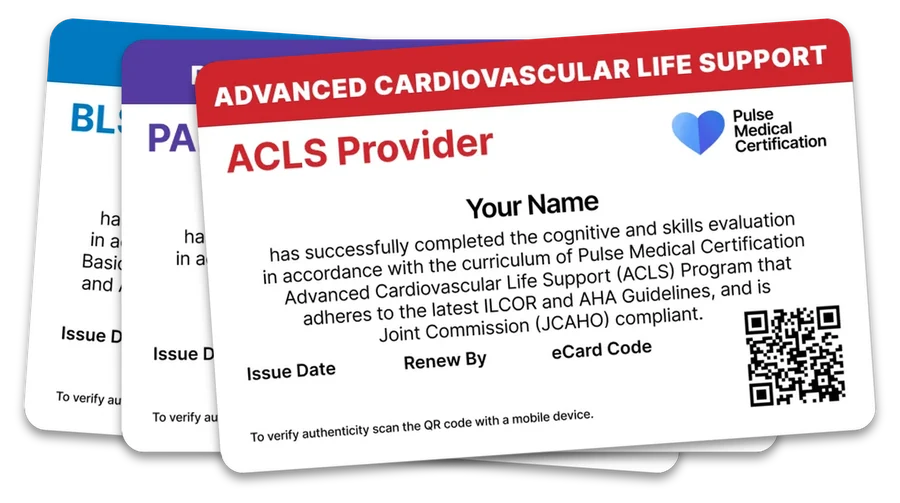
Eligible nurses who complete qualifying Pulse Medical Certification ACLS, PALS, and BLS activities can earn ANCC contact hours through our joint providership with CME Outfitters, LLC.
CME Outfitters is jointly accredited by the Accreditation Council for Continuing Medical Education, the Accreditation Council for Pharmacy Education, and the American Nurses Credentialing Center to provide continuing education for the healthcare team.
For nurses, the eligible activities are designated for:
Activity | ANCC Contact Hours |
|---|---|
8.0 | |
8.0 | |
4.0 |
For California residents, the activity accreditation information identifies California Board of Registered Nursing Provider CEP 15510. For complete accreditation statements and profession-specific credit details, visit our Accreditation & Continuing Education page.
How Do You Claim and Document ANCC Contact Hours?
The exact process depends on the activity provider, but the general sequence is straightforward:
Complete the educational activity. Work through the required content and satisfy the stated participation requirements.
Complete the required assessment and evaluation. Some activities require a post-test, activity evaluation, or another form of demonstrated completion.
Follow the provider’s credit-claiming instructions. For eligible Pulse Medical Certification activities, scan the QR code or use the credit-claiming link provided at the end of the course.
Download your continuing education certificate. Confirm that your name, activity title, completion date, provider, credit type, and number of contact hours are correct.
Report the contact hours where required. Follow the instructions of your state board, certifying organization, employer, or credentialing department.
Keep your documentation. Retain the certificate for at least as long as the applicable board or certifying organization requires.
Reporting is not identical everywhere. ANCC certificants enter eligible professional development activities through their ANCC account, while some state boards use separate electronic reporting systems or require nurses to attest to completion during renewal. Claiming contact hours through an activity provider does not necessarily report them automatically to every organization that may require them.
Keep your certificates available in case of an audit. For example, the California Board of Registered Nursing requires nurses to retain continuing education documentation for four years.
Was this article helpful?
Quick tip: Let us know if this article was helpful and discover a special discount code for your upcoming certification.
Get Certified. Earn CME/CE Credits.
Complete an ACLS, PALS, or BLS certification or recertification course and earn eligible, profession-specific continuing education credit upon successful completion.
Explore All Certifications