Pediatric Cardiac Arrest Algorithm
Last reviewed October 19, 2026 · Based on ILCOR and AHA guidelines 2025-2030
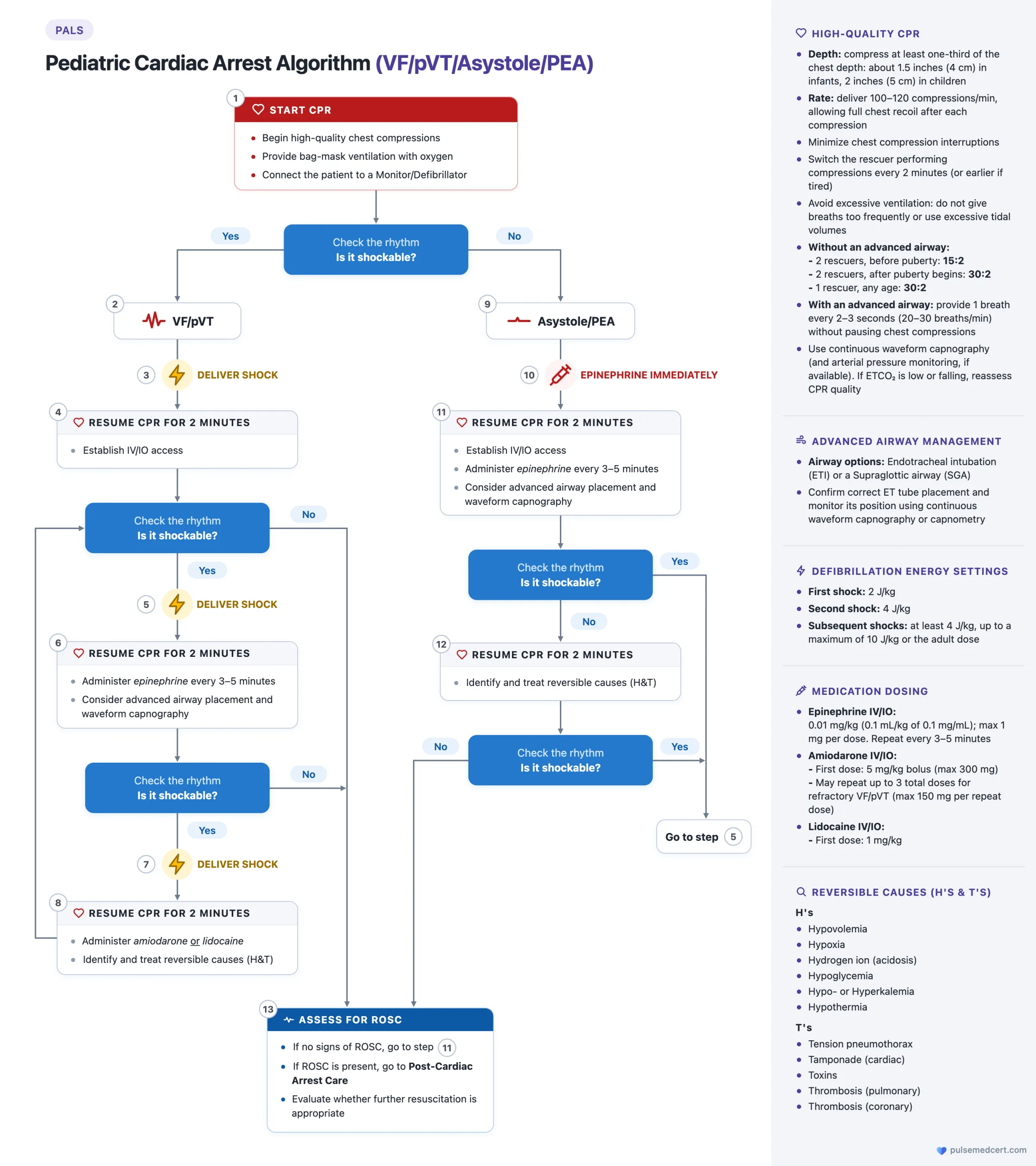
Select the image to open it full size.
Show step-by-step text versionHide step-by-step text version
Pediatric Cardiac Arrest Algorithm: Step by Step
Start CPR
Then check the rhythm. Shockable (VF/pVT): go to step 2. Nonshockable (asystole/PEA): go to step 9.
- Begin high-quality chest compressions
- Provide bag-mask ventilation with oxygen
- Connect the patient to a monitor/defibrillator
VF/pVT
The rhythm is shockable.
Deliver shock
Resume CPR for 2 minutes
Then check the rhythm. Shockable: go to step 5. Not shockable: go to step 13.
- Establish IV/IO access
Deliver shock
Resume CPR for 2 minutes
Then check the rhythm. Shockable: go to step 7. Not shockable: go to step 13.
- Administer epinephrine every 3-5 minutes
- Consider advanced airway placement and waveform capnography
Deliver shock
Resume CPR for 2 minutes
Then return to the rhythm check before step 5.
- Administer amiodarone or lidocaine
- Identify and treat reversible causes (H’s and T’s)
Asystole/PEA
The rhythm is not shockable.
Give epinephrine immediately
Resume CPR for 2 minutes
Then check the rhythm. Shockable: go to step 5. Not shockable: go to step 12.
- Establish IV/IO access
- Administer epinephrine every 3-5 minutes
- Consider advanced airway placement and waveform capnography
Resume CPR for 2 minutes
Then check the rhythm. Shockable: go to step 5. Not shockable: go to step 13.
- Identify and treat reversible causes (H’s and T’s)
Assess for ROSC
- If there are no signs of ROSC, go to step 11
- If ROSC is present, go to post-cardiac arrest care
- Evaluate whether further resuscitation is appropriate
High-quality CPR
- Depth: compress at least one-third of the chest depth: about 1.5 inches (4 cm) in infants and 2 inches (5 cm) in children
- Rate: deliver 100-120 compressions/min, allowing full chest recoil after each compression
- Minimize chest compression interruptions
- Switch the rescuer performing compressions every 2 minutes (or earlier if tired)
- Avoid excessive ventilation: do not give breaths too frequently or use excessive tidal volumes
- Without an advanced airway: 2 rescuers before puberty 15:2; 2 rescuers after puberty begins 30:2; 1 rescuer, any age 30:2
- With an advanced airway: provide 1 breath every 2-3 seconds (20-30 breaths/min) without pausing chest compressions
- Use continuous waveform capnography (and arterial pressure monitoring, if available). If ETCO₂ is low or falling, reassess CPR quality
Advanced airway management
- Airway options: endotracheal intubation (ETI) or a supraglottic airway (SGA)
- Confirm correct ET tube placement and monitor its position using continuous waveform capnography or capnometry
Defibrillation energy settings
- First shock: 2 J/kg
- Second shock: 4 J/kg
- Subsequent shocks: at least 4 J/kg, up to a maximum of 10 J/kg or the adult dose
Medication dosing
- Epinephrine IV/IO: 0.01 mg/kg (0.1 mL/kg of 0.1 mg/mL); max 1 mg per dose. Repeat every 3-5 minutes
- Amiodarone IV/IO: first dose 5 mg/kg bolus (max 300 mg). May repeat up to 3 total doses for refractory VF/pVT (max 150 mg per repeat dose)
- Lidocaine IV/IO: first dose 1 mg/kg
Reversible causes (H’s and T’s)
- H’s: hypovolemia, hypoxia, hydrogen ion (acidosis), hypoglycemia, hypo- or hyperkalemia, hypothermia
- T’s: tension pneumothorax, tamponade (cardiac), toxins, thrombosis (pulmonary), thrombosis (coronary)