Pediatric Systematic Approach Algorithm
Last reviewed October 19, 2026 · Based on ILCOR and AHA guidelines 2025-2030
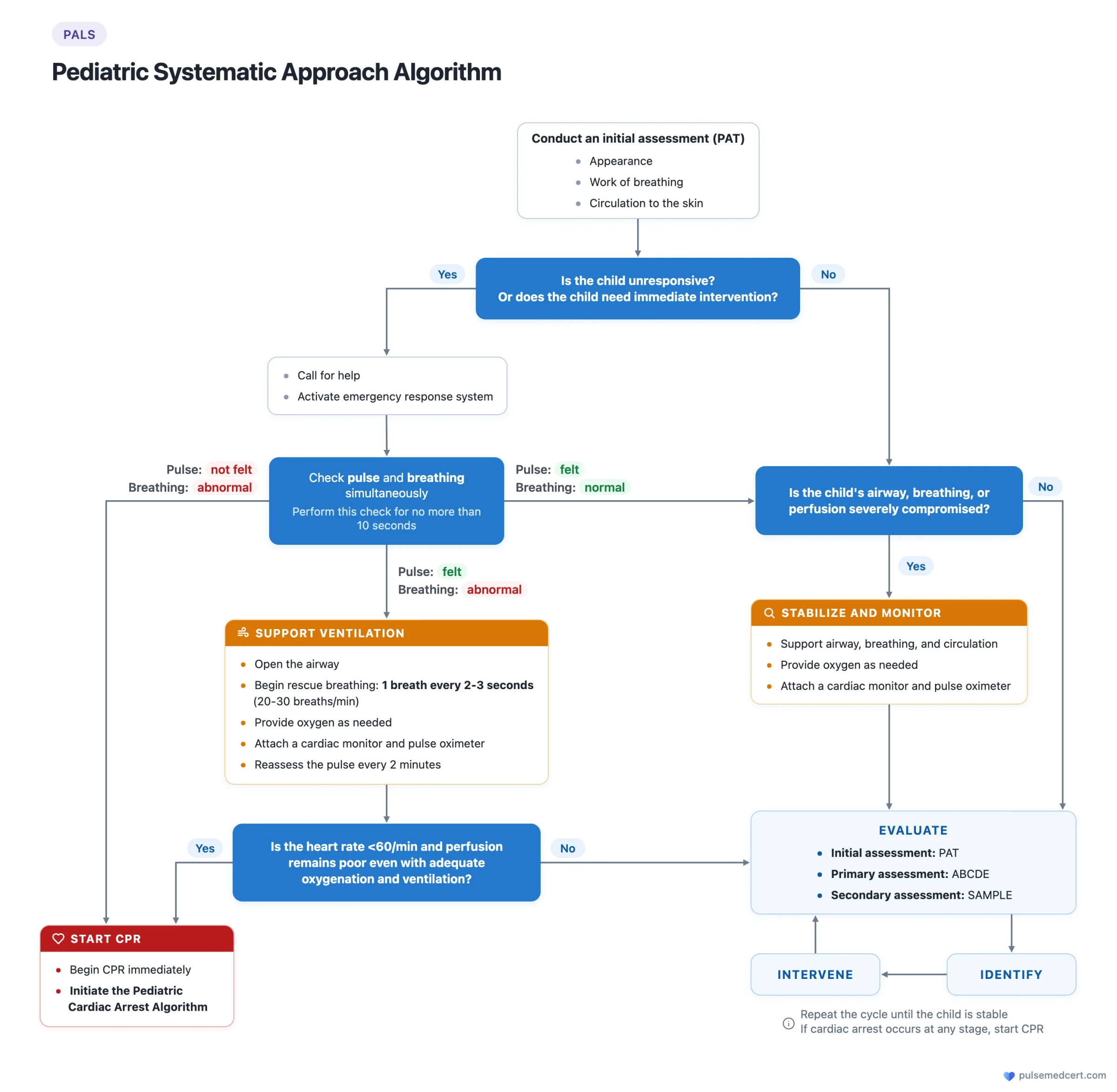
Select the image to open it full size.
Show step-by-step text versionHide step-by-step text version
Pediatric Systematic Approach Algorithm: Step by Step
Conduct an initial assessment (PAT)
- Appearance
- Work of breathing
- Circulation to the skin
Is the child unresponsive, or does the child need immediate intervention?
- Yes: call for help and activate the emergency response system, then check pulse and breathing
- No: check whether the child’s airway, breathing, or perfusion is severely compromised
Check pulse and breathing simultaneously
Perform this check for no more than 10 seconds.
- Pulse not felt, breathing abnormal: start CPR
- Pulse felt, breathing abnormal: support ventilation
- Pulse felt, breathing normal: check whether the child’s airway, breathing, or perfusion is severely compromised
Support ventilation
- Open the airway
- Begin rescue breathing: 1 breath every 2-3 seconds (20-30 breaths/min)
- Provide oxygen as needed
- Attach a cardiac monitor and pulse oximeter
- Reassess the pulse every 2 minutes
Is the heart rate <60/min and perfusion still poor despite adequate oxygenation and ventilation?
- Yes: start CPR
- No: evaluate
Start CPR
- Begin CPR immediately
- Initiate the Pediatric Cardiac Arrest Algorithm
Is the child’s airway, breathing, or perfusion severely compromised?
- Yes: stabilize and monitor, then evaluate
- No: evaluate
Stabilize and monitor
- Support airway, breathing, and circulation
- Provide oxygen as needed
- Attach a cardiac monitor and pulse oximeter
Evaluate, identify, intervene
Repeat the cycle until the child is stable. If cardiac arrest occurs at any stage, start CPR.
- Initial assessment: PAT
- Primary assessment: ABCDE
- Secondary assessment: SAMPLE