Pediatric Post-Cardiac Arrest Care Algorithm
Last reviewed October 19, 2026 · Based on ILCOR and AHA guidelines 2025-2030
Select the image to open it full size.
Show step-by-step text versionHide step-by-step text version
Pediatric Post-Cardiac Arrest Care Algorithm: Step by Step
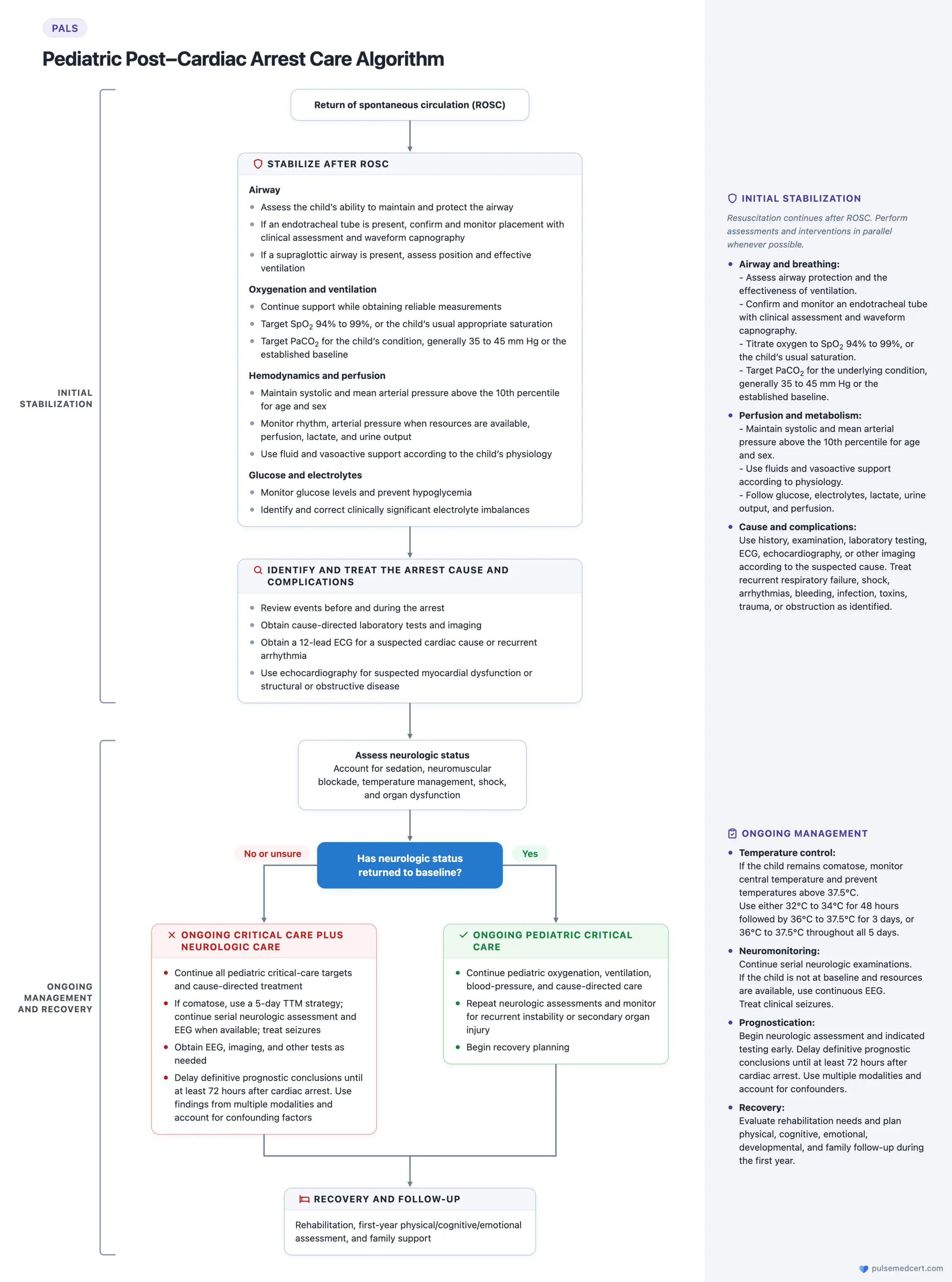
Return of spontaneous circulation (ROSC)
Resuscitation continues after ROSC. Perform assessments and interventions in parallel whenever possible.
Stabilize after ROSC
- Airway: assess the child’s ability to maintain and protect the airway. If an endotracheal tube is present, confirm and monitor placement with clinical assessment and waveform capnography. If a supraglottic airway is present, assess position and effective ventilation
- Oxygenation and ventilation: continue support while obtaining reliable measurements. Target SpO₂ 94% to 99%, or the child’s usual appropriate saturation. Target PaCO₂ for the child’s condition, generally 35 to 45 mm Hg or the established baseline
- Hemodynamics and perfusion: maintain systolic and mean arterial pressure above the 10th percentile for age and sex. Monitor rhythm, arterial pressure when resources are available, perfusion, lactate, and urine output. Use fluid and vasoactive support according to the child’s physiology
- Glucose and electrolytes: monitor glucose levels and prevent hypoglycemia. Identify and correct clinically significant electrolyte imbalances
Identify and treat the arrest cause and complications
- Review events before and during the arrest
- Obtain cause-directed laboratory tests and imaging
- Obtain a 12-lead ECG for a suspected cardiac cause or recurrent arrhythmia
- Use echocardiography for suspected myocardial dysfunction or structural or obstructive disease
Assess neurologic status
Account for sedation, neuromuscular blockade, temperature management, shock, and organ dysfunction.
Has neurologic status returned to baseline?
- No or unsure: ongoing critical care plus neurologic care
- Yes: ongoing pediatric critical care
Not at baseline: ongoing critical care plus neurologic care
- Continue all pediatric critical-care targets and cause-directed treatment
- If comatose, use a 5-day TTM strategy; continue serial neurologic assessment and EEG when available; treat seizures
- Obtain EEG, imaging, and other tests as needed
- Delay definitive prognostic conclusions until at least 72 hours after cardiac arrest. Use findings from multiple modalities and account for confounding factors
At baseline: ongoing pediatric critical care
- Continue pediatric oxygenation, ventilation, blood-pressure, and cause-directed care
- Repeat neurologic assessments and monitor for recurrent instability or secondary organ injury
- Begin recovery planning
Recovery and follow-up
Rehabilitation, first-year physical, cognitive, and emotional assessment, and family support.
Temperature control
If the child remains comatose, monitor central temperature and prevent temperatures above 37.5 °C. Use either 32 °C to 34 °C for 48 hours followed by 36 °C to 37.5 °C for 3 days, or 36 °C to 37.5 °C throughout all 5 days.
Neuromonitoring
Continue serial neurologic examinations. If the child is not at baseline and resources are available, use continuous EEG. Treat clinical seizures.
Prognostication
Begin neurologic assessment and indicated testing early. Delay definitive prognostic conclusions until at least 72 hours after cardiac arrest. Use multiple modalities and account for confounders.
Recovery
Evaluate rehabilitation needs and plan physical, cognitive, emotional, developmental, and family follow-up during the first year.