Adult Acute Coronary Syndromes Algorithm
Last reviewed October 19, 2026 · Based on ILCOR and AHA guidelines 2025-2030
Select the image to open it full size.
Show step-by-step text versionHide step-by-step text version
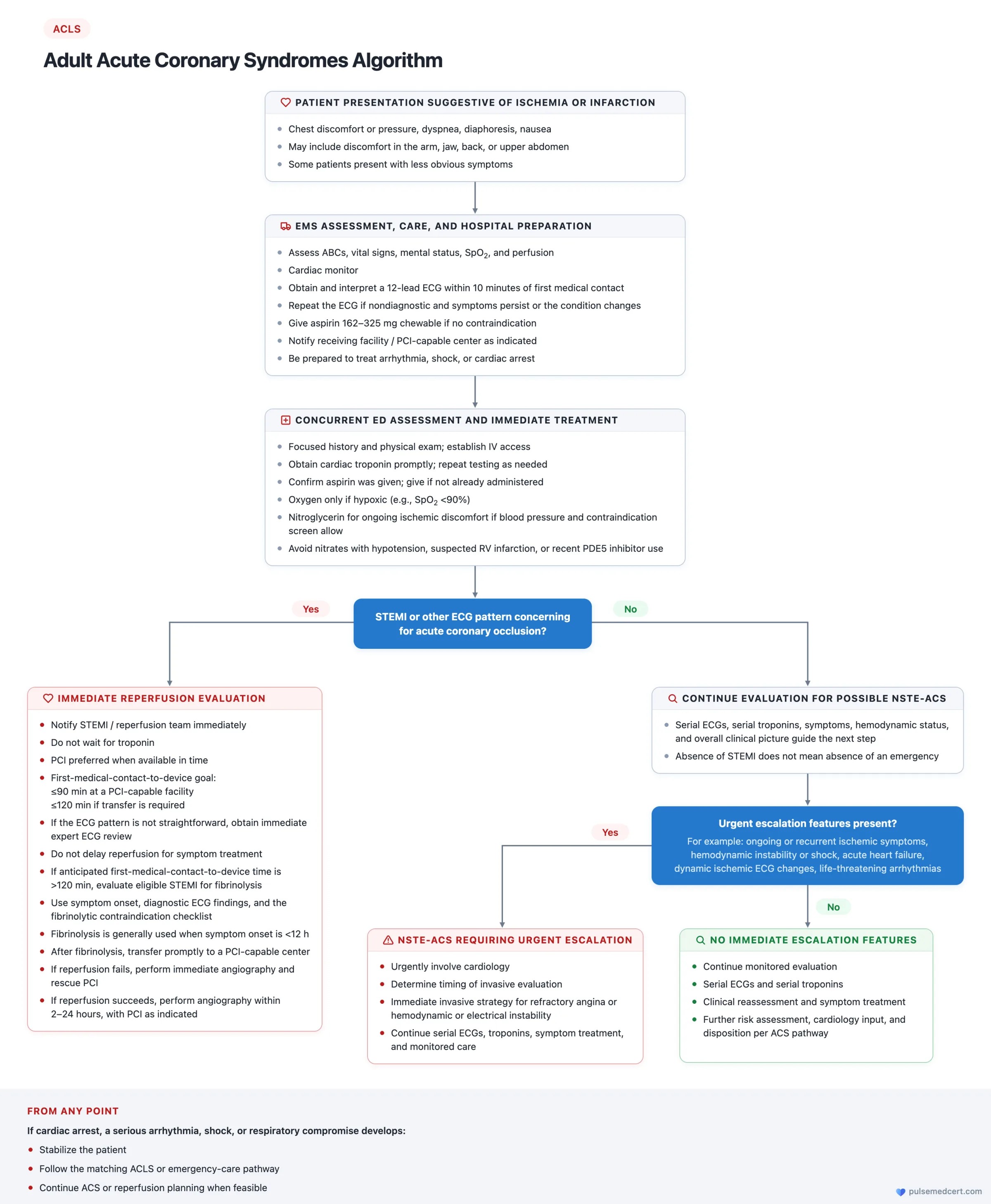
Adult Acute Coronary Syndromes Algorithm: Step by Step
Patient presentation suggestive of ischemia or infarction
- Chest discomfort or pressure, dyspnea, diaphoresis, nausea
- May include discomfort in the arm, jaw, back, or upper abdomen
- Some patients present with less obvious symptoms
EMS assessment, care, and hospital preparation
- Assess ABCs, vital signs, mental status, SpO₂, and perfusion
- Cardiac monitor
- Obtain and interpret a 12-lead ECG within 10 minutes of first medical contact
- Repeat the ECG if nondiagnostic and symptoms persist or the condition changes
- Give aspirin 162-325 mg chewable if no contraindication
- Notify the receiving facility / PCI-capable center as indicated
- Be prepared to treat arrhythmia, shock, or cardiac arrest
Concurrent ED assessment and immediate treatment
- Focused history and physical exam; establish IV access
- Obtain cardiac troponin promptly; repeat testing as needed
- Confirm aspirin was given; give it if not already administered
- Oxygen only if hypoxic (e.g., SpO₂ <90%)
- Nitroglycerin for ongoing ischemic discomfort if blood pressure and contraindication screen allow
- Avoid nitrates with hypotension, suspected RV infarction, or recent PDE5 inhibitor use
STEMI or other ECG pattern concerning for acute coronary occlusion?
- Yes: immediate reperfusion evaluation
- No: continue evaluation for possible NSTE-ACS
Immediate reperfusion evaluation
- Notify the STEMI / reperfusion team immediately
- Do not wait for troponin
- PCI preferred when available in time
- First-medical-contact-to-device goal: ≤90 min at a PCI-capable facility; ≤120 min if transfer is required
- If the ECG pattern is not straightforward, obtain immediate expert ECG review
- Do not delay reperfusion for symptom treatment
- If the anticipated first-medical-contact-to-device time is >120 min, evaluate eligible STEMI for fibrinolysis
- Use symptom onset, diagnostic ECG findings, and the fibrinolytic contraindication checklist
- Fibrinolysis is generally used when symptom onset is <12 h
- After fibrinolysis, transfer promptly to a PCI-capable center
- If reperfusion fails, perform immediate angiography and rescue PCI
- If reperfusion succeeds, perform angiography within 2-24 hours, with PCI as indicated
Continue evaluation for possible NSTE-ACS
Urgent escalation features include ongoing or recurrent ischemic symptoms, hemodynamic instability or shock, acute heart failure, dynamic ischemic ECG changes, and life-threatening arrhythmias.
- Serial ECGs, serial troponins, symptoms, hemodynamic status, and the overall clinical picture guide the next step
- Absence of STEMI does not mean absence of an emergency
Urgent escalation features present: NSTE-ACS requiring urgent escalation
- Urgently involve cardiology
- Determine timing of invasive evaluation
- Immediate invasive strategy for refractory angina or hemodynamic or electrical instability
- Continue serial ECGs, troponins, symptom treatment, and monitored care
No immediate escalation features
- Continue monitored evaluation
- Serial ECGs and serial troponins
- Clinical reassessment and symptom treatment
- Further risk assessment, cardiology input, and disposition per ACS pathway
From any point
If cardiac arrest, a serious arrhythmia, shock, or respiratory compromise develops:
- Stabilize the patient
- Follow the matching ACLS or emergency-care pathway
- Continue ACS or reperfusion planning when feasible