Electrical Cardioversion Algorithm
Last reviewed October 19, 2026 · Based on ILCOR and AHA guidelines 2025-2030
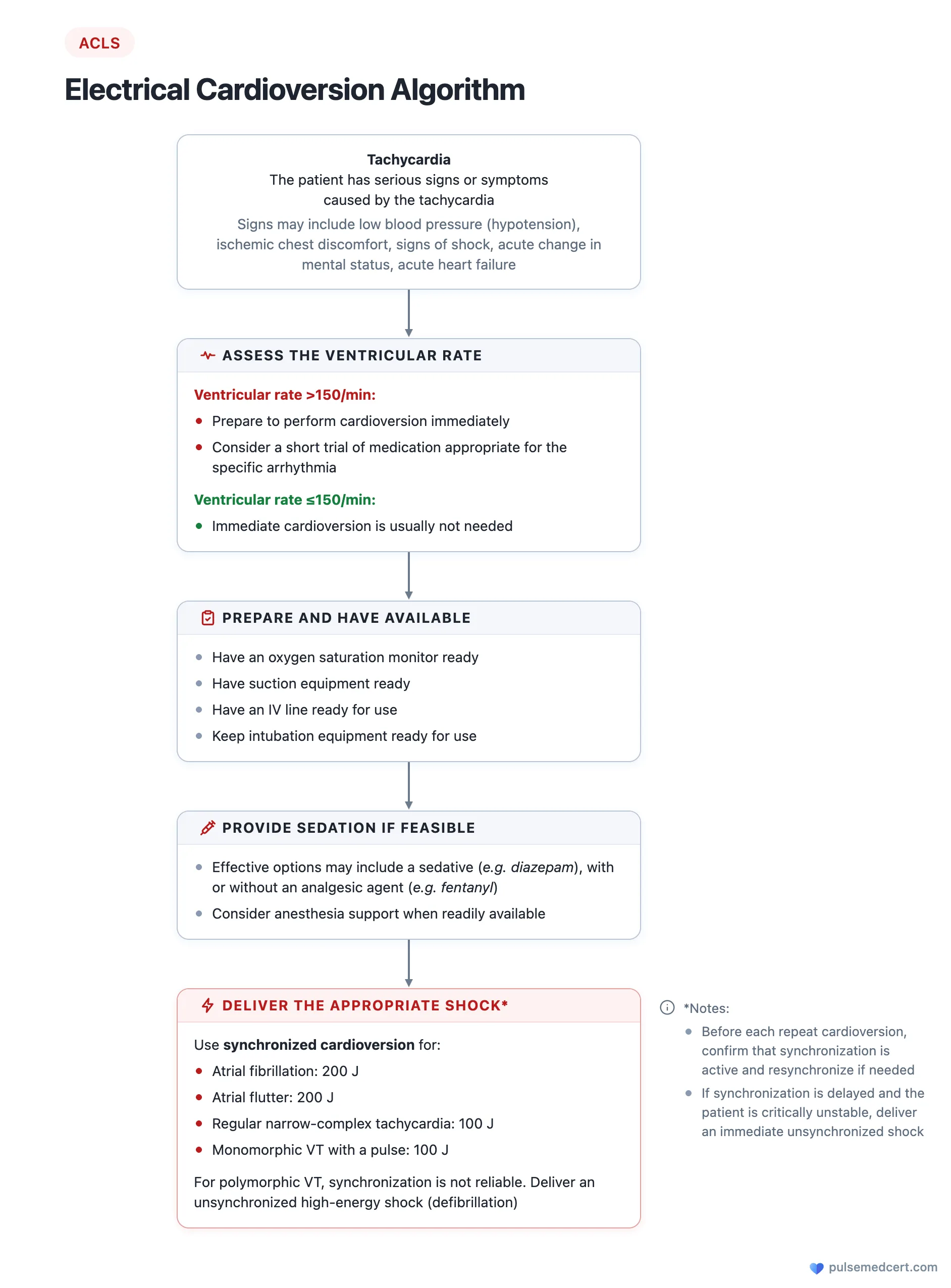
Select the image to open it full size.
Show step-by-step text versionHide step-by-step text version
Electrical Cardioversion Algorithm: Step by Step
Tachycardia with serious signs or symptoms
The patient has serious signs or symptoms caused by the tachycardia. Signs may include low blood pressure (hypotension), ischemic chest discomfort, signs of shock, acute change in mental status, and acute heart failure.
Assess the ventricular rate
- Ventricular rate >150/min: prepare to perform cardioversion immediately. Consider a short trial of medication appropriate for the specific arrhythmia
- Ventricular rate ≤150/min: immediate cardioversion is usually not needed
Prepare and have available
- An oxygen saturation monitor
- Suction equipment
- An IV line ready for use
- Intubation equipment ready for use
Provide sedation if feasible
- Effective options may include a sedative (e.g., diazepam), with or without an analgesic agent (e.g., fentanyl)
- Consider anesthesia support when readily available
Deliver the appropriate shock
Use synchronized cardioversion for:
- Atrial fibrillation: 200 J
- Atrial flutter: 200 J
- Regular narrow-complex tachycardia: 100 J
- Monomorphic VT with a pulse: 100 J
- For polymorphic VT, synchronization is not reliable. Deliver an unsynchronized high-energy shock (defibrillation)
Notes
- Before each repeat cardioversion, confirm that synchronization is active and resynchronize if needed
- If synchronization is delayed and the patient is critically unstable, deliver an immediate unsynchronized shock