Adult Tachyarrhythmia With a Pulse Algorithm
Last reviewed October 19, 2026 · Based on ILCOR and AHA guidelines 2025-2030
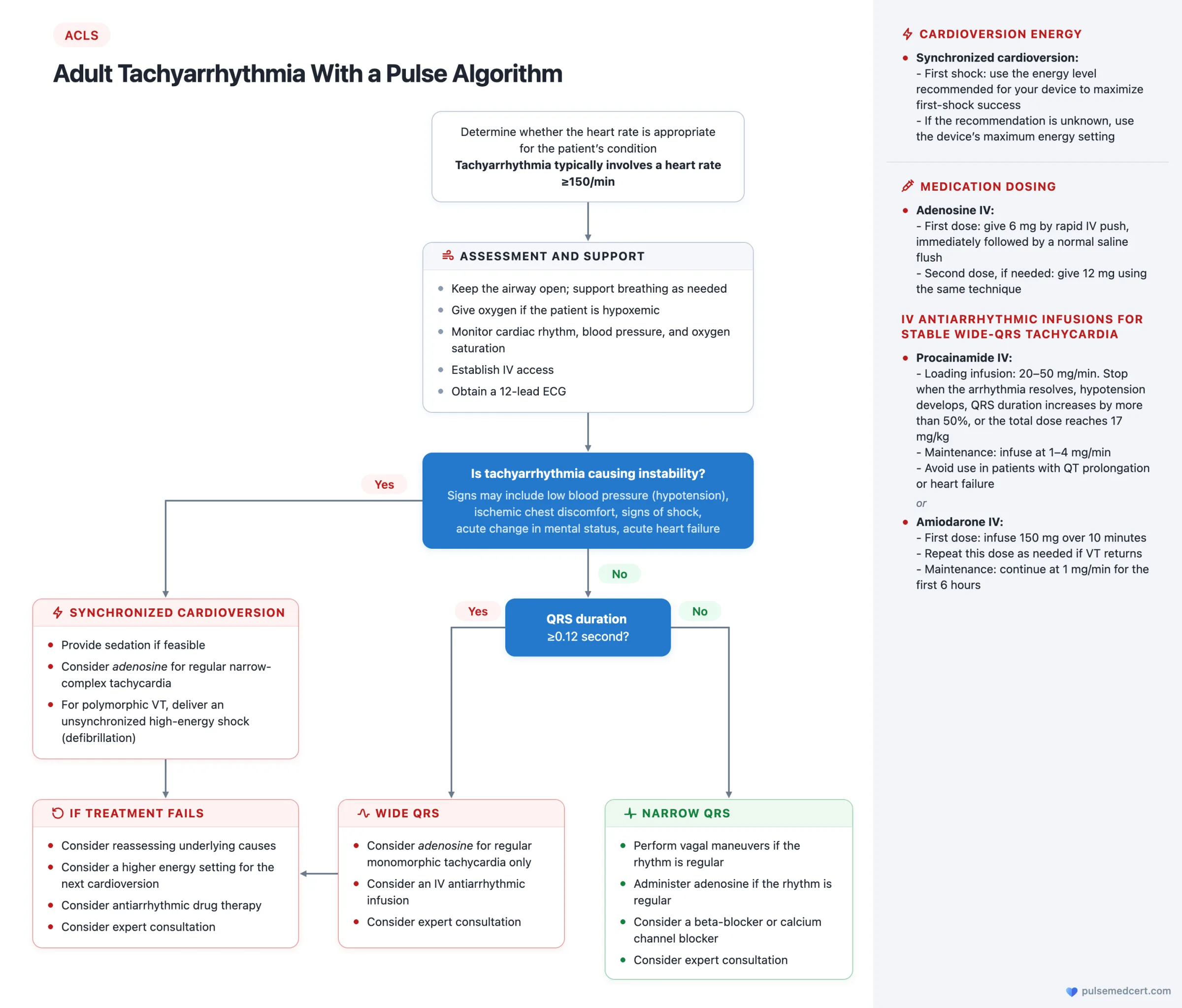
Select the image to open it full size.
Show step-by-step text versionHide step-by-step text version
Adult Tachyarrhythmia With a Pulse Algorithm: Step by Step
Assess the heart rate
Determine whether the heart rate is appropriate for the patient’s condition. Tachyarrhythmia typically involves a heart rate ≥150/min.
Assessment and support
- Keep the airway open; support breathing as needed
- Give oxygen if the patient is hypoxemic
- Monitor cardiac rhythm, blood pressure, and oxygen saturation
- Establish IV access
- Obtain a 12-lead ECG
Is the tachyarrhythmia causing instability?
Signs may include low blood pressure (hypotension), ischemic chest discomfort, signs of shock, acute change in mental status, and acute heart failure.
- Yes: synchronized cardioversion
- No: check the QRS duration
Unstable: synchronized cardioversion
- Provide sedation if feasible
- Consider adenosine for regular narrow-complex tachycardia
- For polymorphic VT, deliver an unsynchronized high-energy shock (defibrillation)
If treatment fails
- Consider reassessing underlying causes
- Consider a higher energy setting for the next cardioversion
- Consider antiarrhythmic drug therapy
- Consider expert consultation
Stable: is the QRS duration ≥0.12 second?
- Yes: wide QRS
- No: narrow QRS
Wide QRS
- Consider adenosine for regular monomorphic tachycardia only
- Consider an IV antiarrhythmic infusion
- Consider expert consultation
Narrow QRS
- Perform vagal maneuvers if the rhythm is regular
- Administer adenosine if the rhythm is regular
- Consider a beta-blocker or calcium channel blocker
- Consider expert consultation
Cardioversion energy
- Synchronized cardioversion, first shock: use the energy level recommended for your device to maximize first-shock success
- If the recommendation is unknown, use the device’s maximum energy setting
Medication dosing
- Adenosine IV, first dose: give 6 mg by rapid IV push, immediately followed by a normal saline flush
- Adenosine IV, second dose if needed: give 12 mg using the same technique
IV antiarrhythmic infusions for stable wide-QRS tachycardia
- Procainamide IV loading infusion: 20-50 mg/min. Stop when the arrhythmia resolves, hypotension develops, QRS duration increases by more than 50%, or the total dose reaches 17 mg/kg
- Procainamide IV maintenance: infuse at 1-4 mg/min. Avoid use in patients with QT prolongation or heart failure
- Or amiodarone IV, first dose: infuse 150 mg over 10 minutes. Repeat this dose as needed if VT returns
- Amiodarone IV maintenance: continue at 1 mg/min for the first 6 hours