Adult Post-Cardiac Arrest Care Algorithm
Last reviewed October 19, 2026 · Based on ILCOR and AHA guidelines 2025-2030
Select the image to open it full size.
Show step-by-step text versionHide step-by-step text version
Adult Post-Cardiac Arrest Care Algorithm: Step by Step
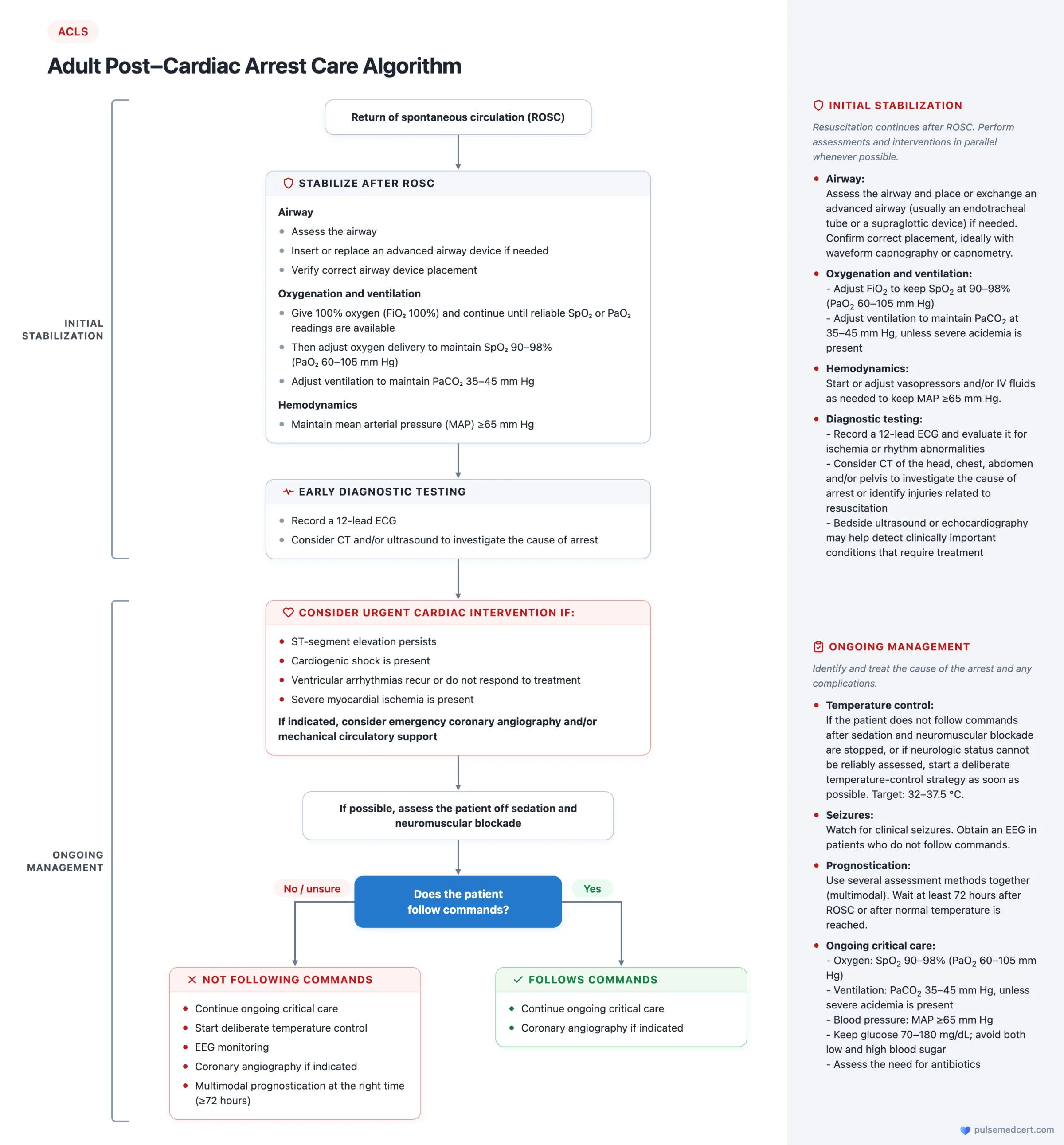
Return of spontaneous circulation (ROSC)
Resuscitation continues after ROSC. Perform assessments and interventions in parallel whenever possible.
Stabilize after ROSC
- Airway: assess the airway, insert or replace an advanced airway device if needed, and verify correct placement
- Oxygenation and ventilation: give 100% oxygen (FiO₂ 100%) until reliable SpO₂ or PaO₂ readings are available, then adjust oxygen delivery to maintain SpO₂ 90-98% (PaO₂ 60-105 mm Hg)
- Adjust ventilation to maintain PaCO₂ 35-45 mm Hg
- Hemodynamics: maintain mean arterial pressure (MAP) ≥65 mm Hg
Early diagnostic testing
- Record a 12-lead ECG
- Consider CT and/or ultrasound to investigate the cause of arrest
Consider urgent cardiac intervention if:
- ST-segment elevation persists
- Cardiogenic shock is present
- Ventricular arrhythmias recur or do not respond to treatment
- Severe myocardial ischemia is present
- If indicated, consider emergency coronary angiography and/or mechanical circulatory support
Does the patient follow commands?
If possible, assess the patient off sedation and neuromuscular blockade.
- No or unsure: not following commands
- Yes: follows commands
Not following commands
- Continue ongoing critical care
- Start deliberate temperature control
- EEG monitoring
- Coronary angiography if indicated
- Multimodal prognostication at the right time (≥72 hours)
Follows commands
- Continue ongoing critical care
- Coronary angiography if indicated
Diagnostic testing
- Record a 12-lead ECG and evaluate it for ischemia or rhythm abnormalities
- Consider CT of the head, chest, abdomen, and/or pelvis to investigate the cause of arrest or identify injuries related to resuscitation
- Bedside ultrasound or echocardiography may help detect clinically important conditions that require treatment
Temperature control
If the patient does not follow commands after sedation and neuromuscular blockade are stopped, or if neurologic status cannot be reliably assessed, start a deliberate temperature-control strategy as soon as possible. Target: 32-37.5 °C.
Seizures
Watch for clinical seizures. Obtain an EEG in patients who do not follow commands.
Prognostication
Use several assessment methods together (multimodal). Wait at least 72 hours after ROSC or after normal temperature is reached.
Ongoing critical care
- Oxygen: SpO₂ 90-98% (PaO₂ 60-105 mm Hg)
- Ventilation: PaCO₂ 35-45 mm Hg, unless severe acidemia is present
- Blood pressure: MAP ≥65 mm Hg
- Keep glucose 70-180 mg/dL; avoid both low and high blood sugar
- Assess the need for antibiotics