Acute Stroke Algorithm
Last reviewed October 19, 2026 · Based on ILCOR and AHA guidelines 2025-2030
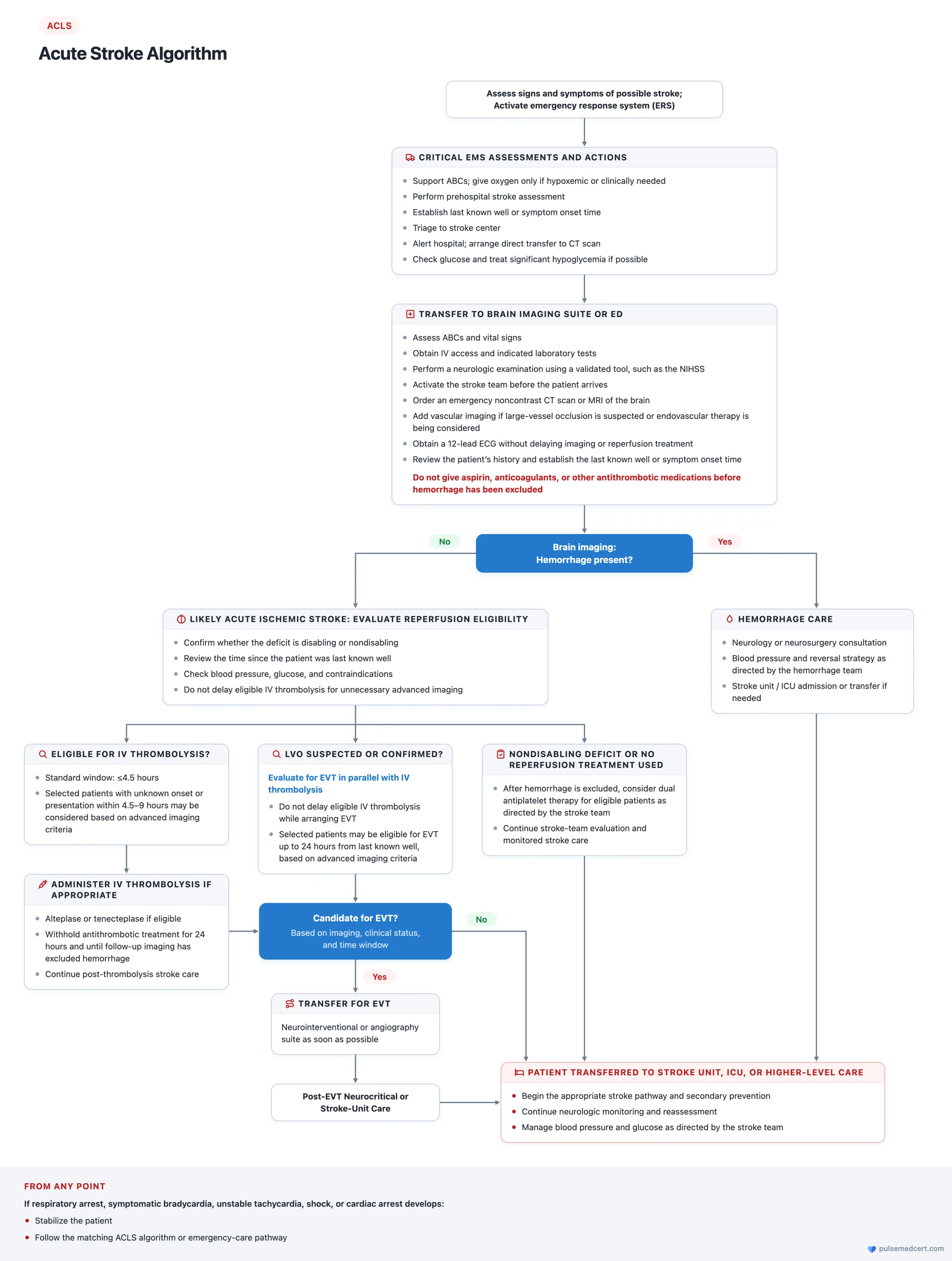
Select the image to open it full size.
Show step-by-step text versionHide step-by-step text version
Acute Stroke Algorithm: Step by Step
Assess signs and symptoms of possible stroke
Activate the emergency response system (ERS).
Critical EMS assessments and actions
- Support ABCs; give oxygen only if hypoxemic or clinically needed
- Perform a prehospital stroke assessment
- Establish the last known well or symptom onset time
- Triage to a stroke center
- Alert the hospital; arrange direct transfer to CT scan
- Check glucose and treat significant hypoglycemia if possible
Transfer to the brain imaging suite or ED
Do not give aspirin, anticoagulants, or other antithrombotic medications before hemorrhage has been excluded.
- Assess ABCs and vital signs
- Obtain IV access and indicated laboratory tests
- Perform a neurologic examination using a validated tool, such as the NIHSS
- Activate the stroke team before the patient arrives
- Order an emergency noncontrast CT scan or MRI of the brain
- Add vascular imaging if large-vessel occlusion is suspected or endovascular therapy is being considered
- Obtain a 12-lead ECG without delaying imaging or reperfusion treatment
- Review the patient’s history and establish the last known well or symptom onset time
Brain imaging: is hemorrhage present?
- Yes: hemorrhage care
- No: likely acute ischemic stroke; evaluate reperfusion eligibility
Hemorrhage care
Then transfer to a stroke unit, ICU, or higher-level care.
- Neurology or neurosurgery consultation
- Blood pressure and reversal strategy as directed by the hemorrhage team
- Stroke unit / ICU admission or transfer if needed
Likely acute ischemic stroke: evaluate reperfusion eligibility
Then evaluate IV thrombolysis, endovascular thrombectomy (EVT), and other stroke care in parallel.
- Confirm whether the deficit is disabling or nondisabling
- Review the time since the patient was last known well
- Check blood pressure, glucose, and contraindications
- Do not delay eligible IV thrombolysis for unnecessary advanced imaging
Eligible for IV thrombolysis?
- Standard window: ≤4.5 hours
- Selected patients with unknown onset or presentation within 4.5-9 hours may be considered based on advanced imaging criteria
Administer IV thrombolysis if appropriate
Then assess whether the patient is a candidate for EVT.
- Alteplase or tenecteplase if eligible
- Withhold antithrombotic treatment for 24 hours and until follow-up imaging has excluded hemorrhage
- Continue post-thrombolysis stroke care
Large-vessel occlusion (LVO) suspected or confirmed?
- Evaluate for EVT in parallel with IV thrombolysis
- Do not delay eligible IV thrombolysis while arranging EVT
- Selected patients may be eligible for EVT up to 24 hours from last known well, based on advanced imaging criteria
Candidate for EVT?
Based on imaging, clinical status, and time window.
- Yes: transfer for EVT to a neurointerventional or angiography suite as soon as possible, followed by post-EVT neurocritical or stroke-unit care
- No: transfer to a stroke unit, ICU, or higher-level care
Nondisabling deficit or no reperfusion treatment used
- After hemorrhage is excluded, consider dual antiplatelet therapy for eligible patients as directed by the stroke team
- Continue stroke-team evaluation and monitored stroke care
Patient transferred to a stroke unit, ICU, or higher-level care
- Begin the appropriate stroke pathway and secondary prevention
- Continue neurologic monitoring and reassessment
- Manage blood pressure and glucose as directed by the stroke team
From any point
If respiratory arrest, symptomatic bradycardia, unstable tachycardia, shock, or cardiac arrest develops:
- Stabilize the patient
- Follow the matching ACLS algorithm or emergency-care pathway